lukaswelker wrote:Hey Guys, here goes the question.
Of the students who eat in a certain cafeteria, each student either likes or dislikes lima beans and each student either like or dislikes Brussels sprouts. Of theses students, 2/3 dislike lima beans; and of those who dislike lima beans; 3/5 also dislike Brussels sprouts. How many of the students like Brussels sprouts but dislike lima beans?
(1) 120 students eat in the cafeteria
(2) 40 of the students like lima beans.
For me both option are not sufficient. Alas it's the contrary. Can you explain me why?
Cheers
Lukas
Solution:
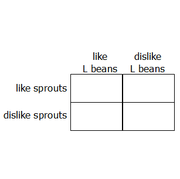
The easiest way to solve this problem is to set up a double set matrix. In our matrix we have two main categories: lima beans and Brussels sprouts. More specifically, our table will be labeled with:
1) Likes lima beans (Like LB)
2) Dislikes lima beans (Dislike LB)
3) Likes Brussels sprouts (Like BS)
4) Dislikes Brussels sprouts (Dislike BS)
(To save room on our table headings we will use the abbreviations for these categories)
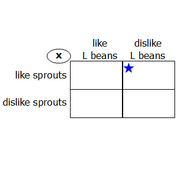
We are not given the total number of students in the question stem, so we label the total number of students as T.
Thus, we know:
Total students = T
Dislikes lima beans = (2/3)T
We are next given that
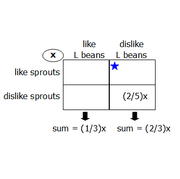
of those who dislike lima beans, 3/5 also dislike Brussels sprouts. Thus we can say that (3/5)(2/3)T = (2/5)T dislike lima beans and dislike Brussels sprouts.
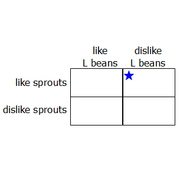
We are trying to determine the number of the students who like Brussels sprouts but dislike lima beans.
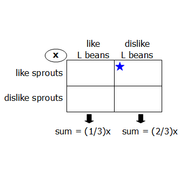
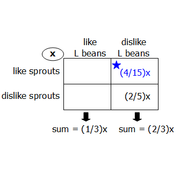
Let's fill all this information into a table. Note that each row sums to create a row total, and each column sums to create a column total. These totals also sum to give us the grand total, designated by T at the bottom right of the table.

Since
(4/15)T represents the number of students who like Brussels sprouts but dislike lima beans, we see that if we know the value of T, then we can determine the number students who like Brussels sprouts but dislike lima beans.
Statement One Alone:
120 students eat in the cafeteria.
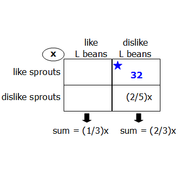
We see that T = 120. Since we have a value for T, we can determine the number students who like Brussels sprouts but dislike lima beans. Statement one alone is sufficient. We can eliminate answers B, C, and E.
Statement Two Alone:
40 of the students like lima beans.
From looking at our chart, we see that (1/3)T students like lima beans. Thus we can say:
(1/3)T = 40
T = 120
Once again, because we have a value for T, we can determine the number of students who like Brussels sprouts but dislike lima beans. Statement two alone is sufficient.
The answer is
D