BREAKING: Target Test Prep releases Brand New 2026 On Demand GMAT prep course

Redeem

Target Test Prep · GMAT

Choose how you want to prepare

Learn live with an expert or move at your own pace. Every option includes the complete TTP study system.

★★★★★5.0559 reviews
GMATLiveTeach 7 seats left
Chris Peckover
NEXT LIVE COHORT

Oct 13 to Jan 7, 2027

with Chris Peckover

Schedule
Tue, Thu · 8:00 to 10:00 PM ET
Included
40 live hours + 6 months of GMAT OnDemand
  • Live instruction and real-time questions
  • Class recordings and assigned practice
View class & enroll
Limited cohort · enrollment openTarget Test Prep
EALiveTeach 5 seats left
Logan Thompson
EXECUTIVE ASSESSMENT

Sep 6 to Dec 6, 2026

with Logan Thompson

Schedule
Sun · 9:30 AM to 12:30 PM ET
Included
40 hours of live online classes plus six months of access to the complete TTP EA OnDemand course.
  • 165+ EA Score Guarantee
  • 4,100+ Quant, Verbal, and Integrated Reasoning practice questions
  • 400+ hours of in-depth video lessons
  • 3,000+ step-by-step video solutions
View EA class & enroll
Limited cohort · enrollment openTarget Test Prep
GMATOnDemand Start anytime
SELF-PACED MASTERCLASS

Target Test Prep GMAT OnDemand

Complete access from day one. Study on your schedule.

715+ score guarantee
$0to start then $127/mo
  • Personalized study plan and analytics
  • Thousands of lessons and practice questions

Compare the format, schedule, and included access before enrolling. Prices and seat counts shown reflect the supplied offer details.

What percent of the residents were born in Town T?

Expert replies
by uououououo » Mon Sep 01, 2014 5:50 pm
"Town T has 20,000 residents, 60 percent of whom are female. What percent of the residents were born in Town T?
(1) The number of female residents who were born in Town T is twice the number of male residents who were not born in Town T.
(2) The number of female residents who were not born in Town T is twice the number of female residents who were born in Town T."


Please help, thanks!
Join the discussion
Source: — Data Sufficiency |

by Uva@90 » Mon Sep 01, 2014 11:07 pm
uououououo wrote:"Town T has 20,000 residents, 60 percent of whom are female. What percent of the residents were born in Town T?
(1) The number of female residents who were born in Town T is twice the number of male residents who were not born in Town T.
(2) The number of female residents who were not born in Town T is twice the number of female residents who were born in Town T."


Please help, thanks!
Hi,
Let, T = Total Number of Population
F = Total number of Female Population
M = Total Number of Male population
FB = Total Number Female population born in Town T
MB = Total Number of Male population born in Town T
FNB = Total Number of population not born in Town T
MNB = Total Number of population not born in Town T

From question we can infer below details,

T = 20000
F = 12000(FB+FNB)
M = 8000(MB+MNB)
T = MB+FB+MNB+FNB

To Find ,
MB +FB ?

Sentence 1: FB = 2MNB
Not enough to find MB+FB

Sentence 2: FNB = 2FB
=> 3X = 12000 => FB = 4000 & FNB = 8000
12000=MB+4000 +MNB+8000
we have two unknown in single equation, not sufficient.

1+2: MNB = 1/2(FB) => 2000

MB = 8000-2000 = 6000

We need MB+FB => 6000+4000 = 10,000.

Hence Sufficient.

OA is C

Regards,
Uva.
Known is a drop Unknown is an Ocean
Join the discussion

by GMATGuruNY » Tue Sep 02, 2014 3:20 am
uououououo wrote:"Town T has 20,000 residents, 60 percent of whom are female. What percent of the residents were born in Town T?
(1) The number of female residents who were born in Town T is twice the number of male residents who were not born in Town T.
(2) The number of female residents who were not born in Town T is twice the number of female residents who were born in Town T."
This is an EITHER/OR group problem.
Every resident is EITHER male OR female.
Every resident is EITHER born in Town T OR not born in Town T.
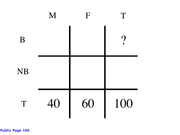
To organize the data, use a GROUP GRID (also known as a double-matrix).

Let M=male, F=female, B=born in Town T, NB=not born in Town T.
Since the question stem asks for a PERCENTAGE, let the total number of residents = 100.
Since 60% of the residents are female, the following grid is yielded:
Image

In a group grid, the values in any row or column must add up to the TOTAL of that row or column, as illustrated by the values in the bottom row.
The question asks for the value in the upper right corner: the total percentage born in Town T.

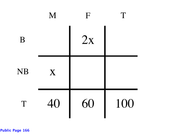
Statement 1: The number of female residents who were born in Town T is twice the number of male residents who were not born in Town T.
The following gird is yielded:
Image
No way to determine the value in the upper right corner.
INSUFFICIENT.

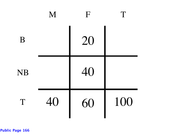
Statement 2: The number of female residents who were not born in Town T is twice the number of female residents who were born in Town T.
The following grid is yielded:
Image
No way to determine the value in the upper right corner.

Statements combined:
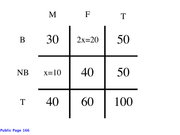
The following grid is yielded:
Image
According to the grid, the total percentage born in Town T = 50%.

The correct answer is C.
Private tutor exclusively for the GMAT and GRE, with over 20 years of experience.
Followed here and elsewhere by over 1900 test-takers.
I have worked with students based in the US, Australia, Taiwan, China, Tajikistan, Kuwait, Saudi Arabia -- a long list of countries.
My students have been admitted to HBS, CBS, Tuck, Yale, Stern, Fuqua -- a long list of top programs.

As a tutor, I don't simply teach you how I would approach problems.
I unlock the best way for YOU to solve problems.

For more information, please email me (Mitch Hunt) at [email protected].
Student Review #1
Student Review #2
Student Review #3
Join the discussion

by Brent@GMATPrepNow » Tue Sep 02, 2014 7:10 am
Mitch's "group grid" approach (aka Double Matrix Method). can be used for most questions featuring a population in which each member has two characteristics associated with it.
Here, we have a population of residents, and the two characteristics are:
- born in Town T and NOT born in Town T
- males or female

This question type is VERY COMMON on the GMAT, so be sure to master the technique.

To learn more about the Double Matrix Method, watch our free video: https://www.gmatprepnow.com/module/gmat- ... ems?id=919

Once you're familiar with this technique, you can attempt these additional practice questions:

Easy Problem Solving questions
- https://www.beatthegmat.com/the-aam-aadm ... 72242.html
- https://www.beatthegmat.com/finance-majo ... 67425.html

Medium Problem Solving questions
- https://www.beatthegmat.com/probability- ... 73360.html
- https://www.beatthegmat.com/posted-speed ... 72374.html
- https://www.beatthegmat.com/motel-t271938.html
- https://www.beatthegmat.com/of-the-appli ... 70255.html
- https://www.beatthegmat.com/opening-nigh ... 64869.html
- https://www.beatthegmat.com/ds-french-ja ... 22297.html

Difficult Problem Solving questions
- https://www.beatthegmat.com/ratio-problem-t268339.html
- https://www.beatthegmat.com/overlapping- ... 65223.html
- https://www.beatthegmat.com/fractions-t264254.html
- https://www.beatthegmat.com/overlapping- ... 64092.html
- https://www.beatthegmat.com/mba/2011/05/ ... question-2

Easy Data Sufficiency questions
- https://www.beatthegmat.com/for-what-per ... 70596.html
- https://www.beatthegmat.com/ds-quest-t187706.html

Medium Data Sufficiency questions
- https://www.beatthegmat.com/sets-matrix-ds-t271914.html
- https://www.beatthegmat.com/each-of-peop ... 71375.html
- https://www.beatthegmat.com/a-manufacturer-t270331.html
- https://www.beatthegmat.com/in-costume-f ... 69355.html
- https://www.beatthegmat.com/mba/2011/05/ ... question-1

Difficult Data Sufficiency questions
- https://www.beatthegmat.com/double-set-m ... 71423.html
- https://www.beatthegmat.com/sets-t269449.html
- https://www.beatthegmat.com/mba/2011/05/ ... question-3

Cheers,
Brent
Brent Hanneson - Creator of GMATPrepNow.com
Image
Join the discussion

by GMATinsight » Tue Sep 02, 2014 10:40 pm
uououououo wrote:"Town T has 20,000 residents, 60 percent of whom are female. What percent of the residents were born in Town T?
(1) The number of female residents who were born in Town T is twice the number of male residents who were not born in Town T.
(2) The number of female residents who were not born in Town T is twice the number of female residents who were born in Town T."


Please help, thanks!
Attachments
Solution 64.jpg
"GMATinsight"Bhoopendra Singh & Sushma Jha
Most Comprehensive and Affordable Video Course 2000+ CONCEPT Videos and Video Solutions
Whatsapp/Mobile: +91-9999687183 l [email protected]
Contact for One-on-One FREE ONLINE DEMO Class Call/e-mail
Most Efficient and affordable One-On-One Private tutoring fee - US$40-50 per hour
Join the discussion


















