BREAKING: Target Test Prep releases Brand New 2026 On Demand GMAT prep course

Redeem

Corodinate Geom PS

Expert replies
Source: — Problem Solving |

Corodinate Geom PS

by Brent@GMATPrepNow » Tue Jun 25, 2013 8:33 pm
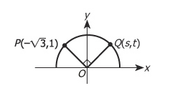
ani781 wrote:Image

Points P, Q lie on the circle with center O. What is the value of S ?
a) 1/2
b) 1
c) 2^(1/2)
d)3^(1/2)
e) (2^1/2)/2[/img]
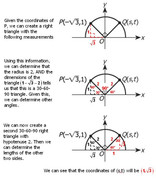
Here's one approach:
Image

So, s = 1
Answer: B

Cheers,
Brent
Last edited by Brent@GMATPrepNow on Mon Apr 16, 2018 12:54 pm, edited 1 time in total.
Brent Hanneson - Creator of GMATPrepNow.com
Image
Join the discussion

by inavdeep » Tue Jun 25, 2013 8:34 pm
Option D : 3^1/2

Here is my Solution:

Since it is a semi-circle therefore the radius remains equal, making it a 45-90-45 Degree Right angled triangle, symmetric about the y-axis. Hence, Option - D.
Join the discussion

by vipulgoyal » Tue Jun 25, 2013 8:40 pm
Algebric Approach

OP = OQ
(1-0)^2 + (-sqrt3-0)^2 = (s-0)^2 + (t-0)^2
1+3 = s^2+t^2

s^2+t^2 = 4 ---------(1)


Since the lines are perpendicular to each other, product of slopes = -1
[(1-0)/(-sqrt3-0)]*[(t-0)/(s-0)] = -1
t/s = sqrt3
t = s*sqrt3
From (1), s^2 + 3s^2 = 4
s^2 = 1
Since (s,t) is in first quadrant, s=1
Join the discussion

by gmattesttaker2 » Wed Sep 25, 2013 8:30 pm
Brent@GMATPrepNow wrote:
ani781 wrote:Image

Points P, Q lie on the circle with center O. What is the value of S ?
a) 1/2
b) 1
c) 2^(1/2)
d)3^(1/2)
e) (2^1/2)/2[/img]
Here's one approach:
Image

So, s = 1
Answer: B

Cheers,
Brent
Hello Brent,

Thanks a lot for the excellent explanation.

Best Regards,
Sri
Join the discussion

by gmattesttaker2 » Wed Sep 25, 2013 8:31 pm
Brent@GMATPrepNow wrote:
ani781 wrote:Image

Points P, Q lie on the circle with center O. What is the value of S ?
a) 1/2
b) 1
c) 2^(1/2)
d)3^(1/2)
e) (2^1/2)/2[/img]
Here's one approach:
Image

So, s = 1
Answer: B

Cheers,
Brent
Hello Brent,

Thanks a lot for the excellent explanation.

Best Regards,
Sri
Join the discussion

by [email protected] » Wed Sep 25, 2013 11:19 pm
Hi inaveep,

In these types of questions, you have to be very careful with your assumptions. Make sure that you have PROOF of what you believe. The drawing is NOT symmetric around the y-axis, but both of those lines are radii. Try drawing in two more right triangles (from the ends of the radii down to the x-axis) and then re-calculate.

GMAT assassins aren't born, they're made,
Rich
Contact Rich at [email protected]
Image
Join the discussion

by gmattesttaker2 » Wed Jun 25, 2014 2:30 pm
Brent@GMATPrepNow wrote:
ani781 wrote:Image

Points P, Q lie on the circle with center O. What is the value of S ?
a) 1/2
b) 1
c) 2^(1/2)
d)3^(1/2)
e) (2^1/2)/2[/img]
Here's one approach:
Image

So, s = 1
Answer: B

Cheers,
Brent

Hello Brent,

Thanks for the explanation. I was wondering that in the 3rd diagram that you have, once we know the value of OQ i.e. 2, what if we draw a straight line from P to Q and then use pythogoras theorem

i.e. 2^2 + 2^2 = PQ^2
=> PQ = 2 sq.root (2)

Hence, the distance from the Y axis to Q in line PQ is (2 sq. root (2))/2 = sq. root (2) and then this distance would the value of s. I was just wondering why this is in-correct? Thanks a lot for your help.

Best Regards,
Sri
Join the discussion

by Brent@GMATPrepNow » Wed Jun 25, 2014 7:24 pm
Hi Sri,

That's a novel approach, but the y-axis does NOT divide the line PQ into two equal pieces. It LOOKS like this might be the case, but it is not so. The diagram is misleading because it is not drawn to scale.

Cheers,
Brent
Brent Hanneson - Creator of GMATPrepNow.com
Image
Join the discussion



















