BREAKING: Target Test Prep releases Brand New 2026 On Demand GMAT prep course

Redeem

Target Test Prep · GMAT

Choose how you want to prepare

Learn live with an expert or move at your own pace. Every option includes the complete TTP study system.

★★★★★5.0559 reviews
GMATLiveTeach 7 seats left
Chris Peckover
NEXT LIVE COHORT

Oct 13 to Jan 7, 2027

with Chris Peckover

Schedule
Tue, Thu · 8:00 to 10:00 PM ET
Included
40 live hours + 6 months of GMAT OnDemand
  • Live instruction and real-time questions
  • Class recordings and assigned practice
View class & enroll
Limited cohort · enrollment openTarget Test Prep
EALiveTeach 5 seats left
Logan Thompson
EXECUTIVE ASSESSMENT

Sep 6 to Dec 6, 2026

with Logan Thompson

Schedule
Sun · 9:30 AM to 12:30 PM ET
Included
40 hours of live online classes plus six months of access to the complete TTP EA OnDemand course.
  • 165+ EA Score Guarantee
  • 4,100+ Quant, Verbal, and Integrated Reasoning practice questions
  • 400+ hours of in-depth video lessons
  • 3,000+ step-by-step video solutions
View EA class & enroll
Limited cohort · enrollment openTarget Test Prep
GMATOnDemand Start anytime
SELF-PACED MASTERCLASS

Target Test Prep GMAT OnDemand

Complete access from day one. Study on your schedule.

715+ score guarantee
$0to start then $127/mo
  • Personalized study plan and analytics
  • Thousands of lessons and practice questions

Compare the format, schedule, and included access before enrolling. Prices and seat counts shown reflect the supplied offer details.

Lima beans

Expert replies
Source: — Problem Solving |

by Brent@GMATPrepNow » Thu Apr 23, 2015 9:24 pm
Of the students who eat in a certain cafeteria, each student either likes or dislikes lima beans and each student either like or dislikes Brussels sprouts. Of theses students, 2/3 dislike lima beans; and of those who dislike lima beans, 3/5 also dislike Brussels sprouts. How many of the students like Brussels sprouts but dislike lima beans?

(1) 120 students eat in the cafeteria
(2) 40 of the students like lima beans.
The answer is, indeed, D

We can use the Double Matrix Method to solve this question. This technique can be used for most questions featuring a population in which each member has two characteristics associated with it.
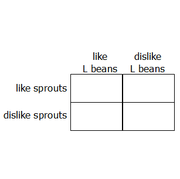
Here, we have a population of students, and the two characteristics are:
- like Brussels sprouts or dislike Brussels sprouts
- like lima beans or dislike lima beans

So, we can set up our diagram as follows:
Image

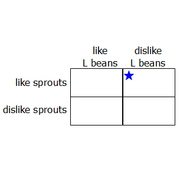
Target question: How many of the students like Brussels sprouts but dislike lima beans?
Let's place a STAR in the box representing those students who like Brussels sprouts but dislike lima beans.
Image

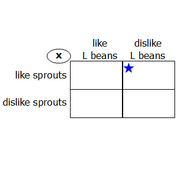
Since we don't know the TOTAL NUMBER of students, let's let x represent the total student population. So, we'll add that to our diagram as well.
Image

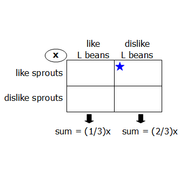
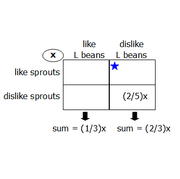
Given: 2/3 dislike lima beans
So, (2/3)x = total number of students who dislike lima beans
This means the other 1/3 LIKE lima beans. In other words, (1/3)x = total number of students who LIKE lima beans.
We'll add that to the diagram:
Image

Given: Of those who dislike lima beans, 3/5 also dislike Brussels sprouts
If (2/3)x = total number of students who dislike lima beans, then (3/5)(2/3)x = total number of students who dislike lima beans AND dislike Brussels sprouts.
(3/5)(2/3)x simplifies to (2/5)x, so we'll add that to our diagram:
Image

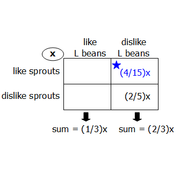
Finally, since the two boxes in the right-hand column must add to (2/3)x, we know that the top-right box must = (4/15)x [since (2/3)x - (2/5)x = (4/15)x]
So, we can add that to the diagram:
Image

Great! We're now ready to examine the statements.

Statement 1: 120 students eat in the cafeteria
In other words, x = 120
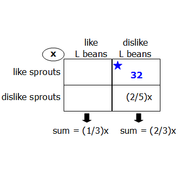
Plug x = 120 into the top-right box to get: (4/15)(120) = 32
So, there are 32 students who like Brussels sprouts but dislike lima beans.
Image
Since we can answer the target question with certainty, statement 1 is SUFFICIENT

Statement 2: 40 of the students like lima beans.
The left-hand column represents students who like lima beans.
In total, (1/3)x = total number of students who LIKE lima beans.
So, statement 2 is telling us that (1/3)x = 40
We can solve the equation to conclude that x = 120
Once we know the value of x, we can determine the number of students who like Brussels sprouts but dislike lima beans (we already did so in statement 1)
Since we can answer the target question with certainty, statement 2 is SUFFICIENT

Answer = D

------------------------------
To learn more about the Double Matrix Method, watch our free video: https://www.gmatprepnow.com/module/gmat- ... ems?id=919

Once you're familiar with this technique, you can attempt these additional practice questions:

Easy Problem Solving questions
- https://www.beatthegmat.com/the-aam-aadm ... 72242.html
- https://www.beatthegmat.com/finance-majo ... 67425.html

Medium Problem Solving questions
- https://www.beatthegmat.com/probability- ... 73360.html
- https://www.beatthegmat.com/posted-speed ... 72374.html
- https://www.beatthegmat.com/motel-t271938.html
- https://www.beatthegmat.com/of-the-appli ... 70255.html
- https://www.beatthegmat.com/opening-nigh ... 64869.html
- https://www.beatthegmat.com/ds-french-ja ... 22297.html

Difficult Problem Solving questions
- https://www.beatthegmat.com/ratio-problem-t268339.html
- https://www.beatthegmat.com/overlapping- ... 65223.html
- https://www.beatthegmat.com/fractions-t264254.html
- https://www.beatthegmat.com/overlapping- ... 64092.html
- https://www.beatthegmat.com/mba/2011/05/ ... question-2

Easy Data Sufficiency questions
- https://www.beatthegmat.com/for-what-per ... 70596.html
- https://www.beatthegmat.com/ds-quest-t187706.html

Medium Data Sufficiency questions
- https://www.beatthegmat.com/sets-matrix-ds-t271914.html
- https://www.beatthegmat.com/each-of-peop ... 71375.html
- https://www.beatthegmat.com/a-manufacturer-t270331.html
- https://www.beatthegmat.com/in-costume-f ... 69355.html
- https://www.beatthegmat.com/mba/2011/05/ ... question-1

Difficult Data Sufficiency questions
- https://www.beatthegmat.com/double-set-m ... 71423.html
- https://www.beatthegmat.com/sets-t269449.html
- https://www.beatthegmat.com/mba/2011/05/ ... question-3

Cheers,
Brent
Brent Hanneson - Creator of GMATPrepNow.com
Image
Join the discussion

by Jeff@TargetTestPrep » Tue May 05, 2015 4:09 am
binaras wrote:Hi,

Need help answering the question in the attached screen shot.

Of the students who eat in a certain cafeteria, each student either likes or dislikes lima beans and each student either like or dislikes Brussels sprouts. Of theses students, 2/3 dislike lima beans; and of those who dislike lima beans, 3/5 also dislike Brussels sprouts. How many of the students like Brussels sprouts but dislike lima beans?

(1) 120 students eat in the cafeteria.
(2) 40 of the students like lima beans.

Binara
Solution:

The easiest way to solve this problem is to set up a double set matrix. In our matrix we have two main categories: lima beans and Brussels sprouts. More specifically, our table will be labeled with:

1) Likes lima beans (Like LB)

2) Dislikes lima beans (Dislike LB)

3) Likes Brussels sprouts (Like BS)

4) Dislikes Brussels sprouts (Dislike BS)

(To save room on our table headings we will use the abbreviations for these categories)

We are not given the total number of students in the question stem, so we label the total number of students as T.

Thus, we know:

Total students = T

Dislikes lima beans = (2/3)T

We are next given that of those who dislike lima beans, 3/5 also dislike Brussels sprouts. Thus we can say that (3/5)(2/3)T = (2/5)T dislike lima beans and dislike Brussels sprouts.

We are trying to determine the number of the students who like Brussels sprouts but dislike lima beans.

Let's fill all this information into a table. Note that each row sums to create a row total, and each column sums to create a column total. These totals also sum to give us the grand total, designated by T at the bottom right of the table.
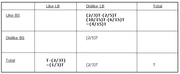
Image

Since (4/15)T represents the number of students who like Brussels sprouts but dislike lima beans, we see that if we know the value of T, then we can determine the number students who like Brussels sprouts but dislike lima beans.

Statement One Alone:

120 students eat in the cafeteria.

We see that T = 120. Since we have a value for T, we can determine the number students who like Brussels sprouts but dislike lima beans. Statement one alone is sufficient. We can eliminate answers B, C, and E.

Statement Two Alone:

40 of the students like lima beans.

From looking at our chart, we see that (1/3)T students like lima beans. Thus we can say:

(1/3)T = 40

T = 120

Once again, because we have a value for T, we can determine the number of students who like Brussels sprouts but dislike lima beans. Statement two alone is sufficient.

The answer is D

Jeffrey Miller
Head of GMAT Instruction
[email protected]

Image

See why Target Test Prep is rated 5 out of 5 stars on BEAT the GMAT. Read our reviews
Join the discussion