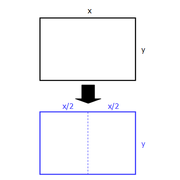
abhasjha wrote:A project requires a rectangular sheet of cardboard satisfying the following requirement: When the sheet is cut into identical rectangular halves, each of the resulting rectangles has the same ratio of length to width as the original sheet. Which of the following sheets comes closest to satisfying the requirement?
(A) A sheet measuring 7 inches by 10 inches
(B) A sheet measuring 8 inches by 14 inches
(C) A sheet measuring 10 inches by 13 inches
(D) A sheet measuring 3 feet by 5 feet
(E) A sheet measuring 5 feet by 8 feet
When the original sheet is cut into identical halves, each of the resulting rectangles has the same ratio of length to width as the original sheet.
This is possible only if the LENGTH of the original sheet is reduced by half, while the original width STAY THE SAME.
We can PLUG IN THE ANSWERS, which represent the dimensions of the original sheet.
To compare the original ratio to the new ratio, CROSS-MULTIPLY.
Answer choice A:
(original width)/(original length) = 7/10.
New ratio = (1/2 the original length)/(original width) = 5/7.
Setting the ratios equal to each other and cross-multiplying, we get:
7/10 = 5/7
7*7 = 10*5
49 = 50.
Looks good.
Answer choice B:
(original width)/(original length) = 8/14.
New ratio = (1/2 the original length)/(original width) = 7/8.
Setting the ratios equal to each other and cross-multiplying, we get:
8/14 = 7/8
8*8 = 14*7
64 = 98.
Since the resulting values in A are closer to each other, eliminate B.
Answer choice C:
(original width)/(original length) = 10/13.
New ratio = (1/2 the original length)/(original width) = 6.5/10 = 13/20.
Setting the ratios equal to each other and cross-multiplying, we get:
10/13 = 13/20
20*10 = 13*13
200 = 169.
Since the resulting values in A are closer to each other, eliminate C.
Answer choice D:
(original width)/(original length) = 3/5.
New ratio = (1/2 the original length)/(original width) = 2.5/3 = 5/6.
Setting the ratios equal to each other and cross-multiplying, we get:
3/5 = 5/6
6*3 = 5*5
18 = 25.
Since the resulting values in A are closer to each other, eliminate D.
Answer choice E:
(original width)/(original length) = 5/8.
New ratio = (1/2 the original length)/(original width) = 4/5.
5/8 = 4/5
5*5 = 8*4
25 = 32.
Since the resulting values in A are closer to each other, eliminate E.
The correct answer is
A.
Private tutor exclusively for the GMAT and GRE, with over 20 years of experience.
Followed here and elsewhere by over 1900 test-takers.
I have worked with students based in the US, Australia, Taiwan, China, Tajikistan, Kuwait, Saudi Arabia -- a long list of countries.
My students have been admitted to HBS, CBS, Tuck, Yale, Stern, Fuqua -- a long list of top programs.
As a tutor, I don't simply teach you how I would approach problems.
I unlock the best way for YOU to solve problems.
For more information, please email me (Mitch Hunt) at
[email protected].
Student Review #1
Student Review #2
Student Review #3