BREAKING: Target Test Prep releases Brand New 2026 On Demand GMAT prep course

Redeem

Circles and tangents

Expert replies
by sukriti2hats » Fri Jun 13, 2014 1:34 am
Looking for a different strategy..

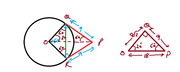
In the given figure, if PQ=9 cm and O is the centre of the circle, then find the length of PO when angle QOR= 60, and PQO =PRO=90.

A) 18 cm
B) 28 cm
C) 13.5 cm
D) 9√3/2 cm
E) 15√3/2 cm

OA: A
Attachments
image.jpg
Join the discussion
Source: — Problem Solving |

by Mathsbuddy » Fri Jun 13, 2014 5:35 am
By Circle Theorem, triangle PQO is a 30-60-90 triangle where Angle QPO = 60 degrees

Hypotenuse PO = 9/cos60 = 9/0.5 = 18
Join the discussion

by GMATinsight » Fri Jun 13, 2014 7:02 am
Hi Sukriti,

PQ = 9, Angle PQO = 90, angle QOP = (1/2)* angle QOR = (1/2)*60 = 30 degrees

Therefore angle QOP = 30 degrees therefore angle QPO = 60 degrees not use 30-60-90 property
The ratio of sides is 1:Sqrt3:2

QP = 9, QO = 9(Sqrt3) and PO = 289 = 18 ANSWER

Refer the image attached for figure
Image
"GMATinsight"Bhoopendra Singh & Sushma Jha
Most Comprehensive and Affordable Video Course 2000+ CONCEPT Videos and Video Solutions
Whatsapp/Mobile: +91-9999687183 l [email protected]
Contact for One-on-One FREE ONLINE DEMO Class Call/e-mail
Most Efficient and affordable One-On-One Private tutoring fee - US$40-50 per hour
Join the discussion

by Brent@GMATPrepNow » Fri Jun 13, 2014 11:38 am
I'd like to mention that this question is made much more difficult by the MISLEADING diagram, which is WAYYYY out of scale. We're told that ∠QOR = 60º, but the angle on the diagram is closer to 180º than to 60º

Please note that the geometric figures in GMAT PROBLEM SOLVING questions are drawn proportionately unless the question explicitly states that the figure is not drawn to scale.

For more about this important feature, you can watch our free video titled "Assumptions and Estimation on the GMAT": https://www.gmatprepnow.com/module/gmat-geometry?id=863

Cheers,
Brent
Brent Hanneson - Creator of GMATPrepNow.com
Image
Join the discussion