BREAKING: Target Test Prep releases Brand New 2026 On Demand GMAT prep course

Redeem

help

Problem Solving — algebra and arithmetic (GMAT Focus Edition)
Expert replies
by sana.noor » Fri Aug 23, 2013 11:12 pm
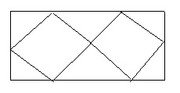
In the figure Shown,two identical squares are inscibed in the rectangle.if the area of the rectangle is 36 Sq. Units,then what is the perimeter of each Square??

Image

i dont have its answer
Work hard in Silence, Let Success make the noise.

If you found my Post really helpful, then don't forget to click the Thank/follow me button. :)
Join the discussion
Source: — Quantitative Reasoning |

by [email protected] » Sat Aug 24, 2013 12:21 am
Hi sana.noor,

In the drawing that you provided, you should notice that:

the width of the rectangle = 2(square's diagonal)
the height of the rectangle = 1(square's diagonal)

Using square "rules", the diagonal = x(root2)

So the area of the rectangle = (width)(height) = 2(x(root2))^2 = 36

Let's simplify:
(x(root2))^2 = 18
x^2(2) = 18
x^2 = 9
x = 3

So the perimeter of each square = 3(4) = 12

GMAT assassins aren't born, they're made,
Rich
Contact Rich at [email protected]
Image
Join the discussion

help

by Brent@GMATPrepNow » Sat Aug 24, 2013 5:36 am
sana.noor wrote: Image

In the figure shown, two identical squares are inscribed in the rectangle. If the area of the rectangle is 36, what is the perimeter of each square?
Here's a slightly different approach:
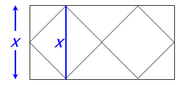
Since the height of the rectangle and the diagonal of a square are the same length, let's let x = height of rectangle
Image

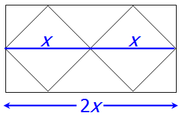
Since the width of the rectangle is equal to the length of two square diagonals, then the width of the rectangle = 2x.
Image

The area of the rectangle is 36.
So, (base)(height) = 36
(2x)(x) = 36
2x²= 36
x²= 18
x = √18

NOTE: There's no need to simplify √18 at this point (you'll see why shortly)

If the height of the rectangle is √18, then the length of the red line (shown below) must equal √18/(2)
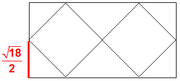
Image

Likewise, the other red line has length √18/(2)
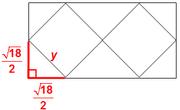
Image

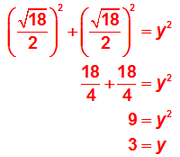
If we let y = the length of the hypotenuse, then the Pythagorean Theorem states that...
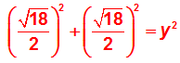
Image

Now solve this equation for y.
Image

If y = 3, then the perimeter of one square = (4)(3) = 12

Cheers,
Brent
Last edited by Brent@GMATPrepNow on Thu Apr 19, 2018 1:41 pm, edited 1 time in total.
Brent Hanneson - Creator of GMATPrepNow.com
Image
Join the discussion

by happy888 » Sun Jan 10, 2016 3:07 pm
Hi Brent,

I didn't understand why 1/4th length of the rectangle is squareroot18/2

Thanks
Join the discussion

by [email protected] » Sun Jan 10, 2016 8:33 pm
Hi happy888,

The 'key' to this whole question is in realizing that the width and height of the rectangle can be expressed in terms of the DIAGONAL of each of the SQUARES. Are you able to follow the 'set-up' of the calculations involved?

GMAT assassins aren't born, they're made,
Rich
Contact Rich at [email protected]
Image
Join the discussion

by Brent@GMATPrepNow » Sun Jan 10, 2016 9:38 pm
happy888 wrote:Hi Brent,

I didn't understand why 1/4th length of the rectangle is squareroot18/2

Thanks
Once we know that the height of the rectangle is √18, then HALF of that is (√18)/2


I hope that helps.

Cheers,
Brent
Brent Hanneson - Creator of GMATPrepNow.com
Image
Join the discussion

by happy888 » Wed Jan 13, 2016 4:40 am
Hi,

Got it

Thanks :)
Join the discussion

by hotcool030 » Sun Jul 02, 2017 4:34 am
I solved it in a very easy way.
Lets take side of square is x. You can see from figure, two diagonals of squares = length of rectangle.
And one diagonal of square = width of rectangle.
So, as Length x Width = 36,
we can say (2 * root2x)* (root2x) = 36
x = 3
Perimeter of square = 12
:)
Join the discussion

by Matt@VeritasPrep » Tue Jul 04, 2017 11:57 pm
hotcool030 wrote:I solved it in a very easy way.
Lets take side of square is x. You can see from figure, two diagonals of squares = length of rectangle.
And one diagonal of square = width of rectangle.
So, as Length x Width = 36,
we can say (2 * root2x)* (root2x) = 36
x = 3
Perimeter of square = 12
:)
Nice approach! For anyone needing a visual, this is the same approach the great Brent uses above.
Join the discussion

by Ian Stewart » Fri Jul 07, 2017 3:27 pm
The squares just take up half the rectangle. There are a few ways to see that. For example, if you divide up the picture into a grid of 8 squares, as I did below, you can see that half of each grid zone is taken up by part of a square, and the other half is taken up by non-square.

So the area of the squares is half the total area of the rectangle, so the area of the two squares is 36/2 = 18, and the area of each square is 9. So the squares measure 3 by 3, and the perimeter of each is 12.
Attachments
Screen Shot 2017-07-07 at 7.14.51 PM.png
For online GMAT math tutoring, or to buy my higher-level Quant books and problem sets, contact me at ianstewartgmat at gmail.com

ianstewartgmat.com
Join the discussion

help

by Matt@VeritasPrep » Fri Aug 18, 2017 1:22 pm
Neat follow up question for anyone who wants to delve further into similar ideas:

https://www.beatthegmat.com/triangle-in ... 16268.html
Join the discussion

by hopperyelena » Fri Nov 24, 2017 4:52 am
thanks..
Join the discussion

by Matt@VeritasPrep » Thu Dec 07, 2017 3:57 pm
Join the discussion