A rectangle has sides x and y and diagonal z. What is the pe

This topic has expert replies
Source: — Data Sufficiency |

GMAT/MBA Expert

User avatar
GMAT Instructor
Posts: 2623
Joined: Mon Jun 02, 2008 3:17 am
Location: Montreal
Thanked: 1090 times
Followed by:355 members
GMAT Score:780

by Ian Stewart » Thu Mar 14, 2019 4:44 am

Timer

00:00

Your Answer

A

B

C

D

E

Global Stats

Statement 1 is not sufficient, since the sides could be anything. Statement 2 also isn't sufficient, because you'll have different perimeters when, say, the quadrilateral is a square and when it isn't.

Using both statements, squaring the equation in statement 1, we learn

x^2 + y^2 - 2xy = 49

and because of Pythagoras, we know from Statement 2 that x^2 + y^2 = 13^2 = 169. Plugging "169" in above for "x^2 + y^2" we learn

169 - 2xy = 49
2xy = 120
xy = 60

Since x = y +7, we can now substitute for x:

(y+7)(y) = 60

If y is positive, as you make y bigger, the left side of the equation above gets bigger, so there can only be one value of y that makes (y+7)(y) exactly equal to 60, and the information is sufficient, since with the value of y we can find x and thus find the perimeter. Of course if we want to find that solution, we can either do so by inspection (we just want two numbers that differ by 7 and multiply to 60, so those numbers are 5 and 12) or we can factor the quadratic we get by expanding the left side. There's also a negative solution that we ignore since y is a length. So the answer is C.
For online GMAT math tutoring, or to buy my higher-level Quant books and problem sets, contact me at ianstewartgmat at gmail.com

ianstewartgmat.com

User avatar
GMAT Instructor
Posts: 15539
Joined: Tue May 25, 2010 12:04 pm
Location: New York, NY
Thanked: 13060 times
Followed by:1906 members
GMAT Score:790

by GMATGuruNY » Fri Mar 15, 2019 6:48 am

Timer

00:00

Your Answer

A

B

C

D

E

Global Stats

BTGmoderatorDC wrote:A rectangle has sides x and y and diagonal z. What is the perimeter of the rectangle?

(1) x - y = 7.
(2) z = 13.

OA C

Source: Princeton Review
Always look for special triangles such as 3-4-5 and 5-12-13.

Statement 2:
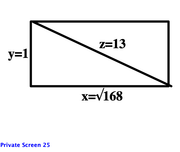
Case 1:
Image
Case 2:
Image
Since each case will yield a different perimeter, INSUFFICIENT.

Statement 1:
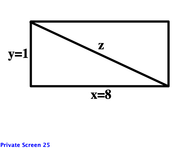
Case 1:
Image
Case 3:
Image
Since each case will yield a different perimeter, INSUFFICIENT.

Statements combined:
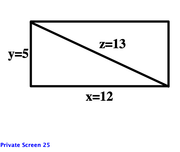
Since only a 5-12-13 triangle has both legs with a difference of 7 and a hypotenuse of 13, only Case 1 is viable:
Image
Thus, the perimeter of the rectangle can be determined.
SUFFICIENT.

The correct answer is C.
Private tutor exclusively for the GMAT and GRE, with over 20 years of experience.
Followed here and elsewhere by over 1900 test-takers.
I have worked with students based in the US, Australia, Taiwan, China, Tajikistan, Kuwait, Saudi Arabia -- a long list of countries.
My students have been admitted to HBS, CBS, Tuck, Yale, Stern, Fuqua -- a long list of top programs.

As a tutor, I don't simply teach you how I would approach problems.
I unlock the best way for YOU to solve problems.

For more information, please email me (Mitch Hunt) at [email protected].
Student Review #1
Student Review #2
Student Review #3

Legendary Member
Posts: 2214
Joined: Fri Mar 02, 2018 2:22 pm
Followed by:5 members

by deloitte247 » Mon Mar 18, 2019 11:40 pm

Timer

00:00

Your Answer

A

B

C

D

E

Global Stats

For a rectangle, 2 sides are equal, and with diagonal z, we will b having a right angled triangle.
By Pythagoras,
$$z^2=x^2+y^2$$
We are looking for the perimeter of the rectangle,
Let the perimeter = P
$$P=2\left(x+y\right)\ find\ P$$

Statement 1
$$x-y=7$$
This means that x and y can be 1 and 6, 2 and 5, 3 and 4, 0 and 7 respectively and alternatively since there is no definite conclusion, statement 1 is INSUFFICIENT.

Statement 2
z = 13 ; with pythagoras theorem
$$z^2=x^2+y^2$$
$$13^2=x^2+y^2$$
$$169=x^2+y^2$$
Lots of value can also satisfy the equation, hence statement 2 is INSUFFICIENT.

Combining statement 1 and 2 together
Statement 1 : x+y =7
y = 7 - x and z = 13
From pythagoras
$$z^2=x^2+y^2$$
where y = 7- x and z = 13
$$13^2=x^2+\left(7-x\right)^2$$
$$13^2=x^2+\left(7-x\right)\left(7-x\right)$$
$$13^2=x^2+49-7x-7x+x^2$$
$$169=x^2+49-14x+x^2$$
$$169=2x^2-14x+49$$
$$2x^2-14x+49-169=0$$
$$2x^2-14x-120=0\left(Quadratic\ equation\ \right)$$
$$2x^2-24x+10x-120=0$$
$$\left(2x^2-24x\right)+\left(10x-120\right)=0$$
$$2x\left(x-12\right)+10\left(x-12\right)=0$$
$$2x+10=0\ or\ x-12=0$$
$$x=-5\ OR\ x=12$$
(x cannot be a negative integer)
from x + y = 7 where x = 12
12 + y =7
y = 5, the P = 2 (x+y) = 2 (17) = 34
Both statements together are SUFFICIENT.

$$Answer\ is\ Option\ C$$