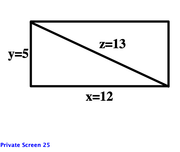
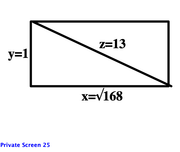
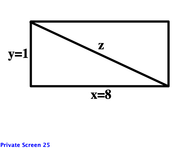
Statement 1 is not sufficient, since the sides could be anything. Statement 2 also isn't sufficient, because you'll have different perimeters when, say, the quadrilateral is a square and when it isn't.
Using both statements, squaring the equation in statement 1, we learn
x^2 + y^2 - 2xy = 49
and because of Pythagoras, we know from Statement 2 that x^2 + y^2 = 13^2 = 169. Plugging "169" in above for "x^2 + y^2" we learn
169 - 2xy = 49
2xy = 120
xy = 60
Since x = y +7, we can now substitute for x:
(y+7)(y) = 60
If y is positive, as you make y bigger, the left side of the equation above gets bigger, so there can only be one value of y that makes (y+7)(y) exactly equal to 60, and the information is sufficient, since with the value of y we can find x and thus find the perimeter. Of course if we want to find that solution, we can either do so by inspection (we just want two numbers that differ by 7 and multiply to 60, so those numbers are 5 and 12) or we can factor the quadratic we get by expanding the left side. There's also a negative solution that we ignore since y is a length. So the answer is C.
For online GMAT math tutoring, or to buy my higher-level Quant books and problem sets, contact me at ianstewartgmat at gmail.com
ianstewartgmat.com