BlueDragon2010 wrote:Is the number of members of Club X greater than the number of members of Club Y?
1) Of the members of Club X, 20 percent are also members of Club Y.
2) Of the members of Club Y, 30 percent are also members of Club X.
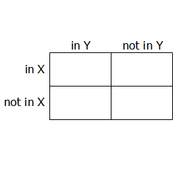
Another approach is to use the Double Matrix Method. This technique can be used for most questions featuring a population in which each member has two characteristics associated with it.
Here, we have a population of people, and the two characteristics are:
- member of Club X or not a member of Club X
- member of Club Y or not a member of Club Y
So, we can set up our diagram as follows:
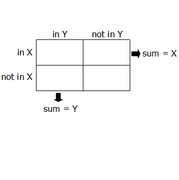
Since we're not told any populations, let's assign some variables.
Let X = # of Club X members
Let Y = # of Club Y members
So, we now have a diagram that looks like this:
Okay, now let's solve the question...
Target question: Is X greater than Y?
Statement 1: Of the members of Club X, 20 percent are also members of Club Y.
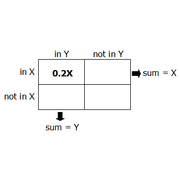
If X people are in Club X, then the number of THESE people whose are ALSO in Club Y = 20% of X (aka 0.2X)
So, let's add this to our diagram:
Does this provide enough information to determine
whether or not X is greater than Y?
No. The reason is that we have no information about the bottom-left box:
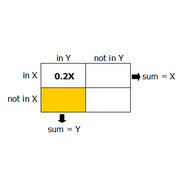
Since there are no restrictions on the bottom-left box, there are many possible ways to complete the diagram so that we get CONFLICTING answers to the
target question. Here are two:
Case a:
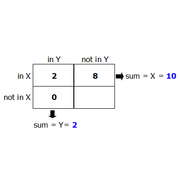
In this case X = 10 and Y = 2, which means
X is GREATER THAN Y
Case b:
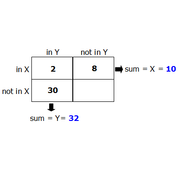
In this case X = 10 and Y = 32, which means
X is LESS THAN Y
Since we cannot answer the
target question with certainty, statement 1 is NOT SUFFICIENT
Statement 2: Of the members of Club Y, 30 percent are also members of Club X.
If Y people are in Club Y, then the number of THESE people whose are ALSO in Club X = 30% of Y (aka 0.3Y)
So, let's add this to our diagram:
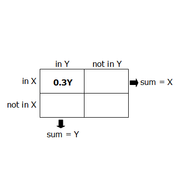
Using logic similar to the logic we used in statement 1, we can conclude that statement 2 is NOT SUFFICIENT
Statements 1 and 2 combined
When we combine the information we get TWO POSSIBLE expressions for the top-left corner:
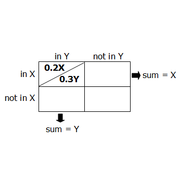
So, these two expressions must be equal.
In other words, 0.2X = 0.3Y
Divide both sides by 0.2 to get: X = (0.3/0.2)Y
Simplify to get: X = 1.5Y
Since X and Y must be positive integers, the expression X = 1.5Y tells us that X is 1.5 TIMES as big as Y
In other words,
X is definitely greater than Y
Since we can answer the
target question with certainty, the combined statements are SUFFICIENT
Answer =
C
Cheers,
Brent
----------------------------
To learn more about the Double Matrix Method, watch our free video:
https://www.gmatprepnow.com/module/gmat- ... ems?id=919
Once you're familiar with the technique, you can attempt these additional practice questions:
Easy Problem Solving questions
-
https://www.beatthegmat.com/the-aam-aadm ... 72242.html
-
https://www.beatthegmat.com/finance-majo ... 67425.html
Medium Problem Solving questions
-
https://www.beatthegmat.com/probability- ... 73360.html
-
https://www.beatthegmat.com/posted-speed ... 72374.html
-
https://www.beatthegmat.com/motel-t271938.html
-
https://www.beatthegmat.com/of-the-appli ... 70255.html
-
https://www.beatthegmat.com/opening-nigh ... 64869.html
-
https://www.beatthegmat.com/ds-french-ja ... 22297.html
Difficult Problem Solving questions
-
https://www.beatthegmat.com/ratio-problem-t268339.html
-
https://www.beatthegmat.com/overlapping- ... 65223.html
-
https://www.beatthegmat.com/fractions-t264254.html
-
https://www.beatthegmat.com/overlapping- ... 64092.html
-
https://www.beatthegmat.com/mba/2011/05/ ... question-2
Easy Data Sufficiency questions
-
https://www.beatthegmat.com/for-what-per ... 70596.html
-
https://www.beatthegmat.com/ds-quest-t187706.html
Medium Data Sufficiency questions
-
https://www.beatthegmat.com/sets-matrix-ds-t271914.html
-
https://www.beatthegmat.com/each-of-peop ... 71375.html
-
https://www.beatthegmat.com/a-manufacturer-t270331.html
-
https://www.beatthegmat.com/in-costume-f ... 69355.html
-
https://www.beatthegmat.com/mba/2011/05/ ... question-1
Difficult Data Sufficiency questions
-
https://www.beatthegmat.com/double-set-m ... 71423.html
-
https://www.beatthegmat.com/sets-t269449.html
-
https://www.beatthegmat.com/mba/2011/05/ ... question-3






















