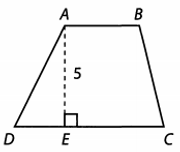
ABCD is a quadrilateral, with AB parallel to CD...

This topic has expert replies
Moderator
Posts: 2505
Joined: Sun Oct 15, 2017 1:50 pm
Followed by:6 members
Image

ABCD is a quadrilateral, with AB parallel to CD (see figure). E is a point between C and D such that AE represent the height of ABCD, and E is the mispoint to CD. If Ab is 4 inches long, AE is 5 inches long, and the area of triangle AED is 12.5 square inches, what is the area of ABCD? (Note: figure not drawn to scale)

A. 30 square inches
B. 35 square inches
C. 40 square inches
D. 45 square inches
E. 50 square inches

The OA is B.

I'm really confused with this PS question. Please, can any expert assist me with it? Thanks in advanced.
Source: — Problem Solving |

User avatar
GMAT Instructor
Posts: 555
Joined: Wed Oct 04, 2017 4:18 pm
Thanked: 180 times
Followed by:12 members

by EconomistGMATTutor » Tue Dec 19, 2017 6:03 am
Hello LUANDATO.

Let's take a look at your question.

First of all, the area of ABCD is $$\frac{\left(AB+CD\right)\cdot AE}{2}=\frac{\left(4+CD\right)\cdot5}{2}=\frac{\left(4+2\cdot DE\right)\cdot5}{2}.$$ So we just need to find the value of DE.

We know that the area of the right triangle AED is 12.5. That is to say, $$12.5=\frac{DE\cdot5}{2}\ \leftrightarrow\ \ DE=\frac{25}{5}=5.$$ So, the area of ABCD is equal to $$\frac{\left(4+2\cdot5\right)\cdot5}{2}=\frac{14\cdot5}{2}=35.$$ This is why the correct answer is B.

I hope this explanation may help you.

I'm available if you'd like a follow-up.

Regards.
GMAT Prep From The Economist
We offer 70+ point score improvement money back guarantee.
Our average student improves 98 points.

Image