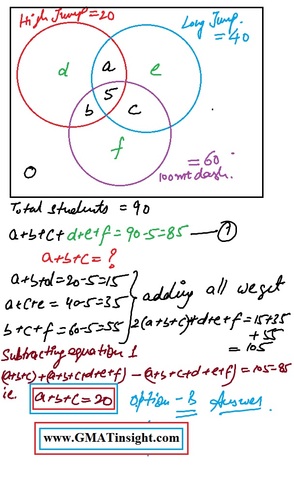
mgm wrote:Each of 90 students participated at least 1 of the track tryouts: High jump, long jump, 100 meter dash. If 20 students participated in high jump tryout, 40 students participated in the long jump tryout and 60 students participated in the 100 meter dash tryout, and if 5 students participated in all 3 tryouts, how many students participated in only two of these tryouts?
(A) 25
(B) 20
(C) 15
(D) 10
(E) 5
[spoiler]OA: B[/spoiler]
Here is the formula for 3 overlapping groups:
T = A + B + C - (AB + AC + BC) - 2(ABC)
The big idea with overlapping group problems is to SUBTRACT THE OVERLAPS.
When we add together everyone in A, everyone in B, and everyone in C:
Those in exactly 2 of the groups (AB+AC+BC) are counted twice, so they need to be subtracted from the total ONCE.
Those in all 3 groups (ABC) are counted 3 times, so they need to be subtracted from the total TWICE.
By subtracting the overlaps, we ensure that no one is overcounted.
In the problem above:
T = 90.
A = high jump = 20.
B = long jump = 40.
C = dash = 60.
The number participating in exactly 2 events = AB + AC + BC = x.
Since 5 students participate in all 3 events, ABC = 5.
Plugging these values into the formula, we get:
90 = 20 + 40 + 60 - x - 2(5)
x = 20.
The correct answer is
B.
Private tutor exclusively for the GMAT and GRE, with over 20 years of experience.
Followed here and elsewhere by over 1900 test-takers.
I have worked with students based in the US, Australia, Taiwan, China, Tajikistan, Kuwait, Saudi Arabia -- a long list of countries.
My students have been admitted to HBS, CBS, Tuck, Yale, Stern, Fuqua -- a long list of top programs.
As a tutor, I don't simply teach you how I would approach problems.
I unlock the best way for YOU to solve problems.
For more information, please email me (Mitch Hunt) at
[email protected].
Student Review #1
Student Review #2
Student Review #3