BREAKING: Target Test Prep releases Brand New 2026 On Demand GMAT prep course

Redeem

Standard deviation

Expert replies
by taneja.niks » Tue Jun 29, 2010 9:45 am
At Rocktown College, the 400 students taking Psychology 101
received an average score of 76 on the final exam, and the
scores had a normal distribution. The bottom 16 percent of
scorers will receive a failing grade. What is the score at or
below which students fail the course?
(1) 8 students receive a score of 96 or higher.
(2) The standard deviation for the final exam was 10
points.


please provide me with the answer and explanation of this one.
Join the discussion
Source: — Data Sufficiency |

by albatross86 » Tue Jun 29, 2010 10:58 am
This question requires knowledge of the characteristics of a normal distribution. I am unsure about whether this is within the scope of the GMAT, but there seems to be some confusion about this. Some students have recently claimed to have seen questions like this pop up, so here's a solution anyway. I recommend you don't spend too much time on this if you don't understand it.

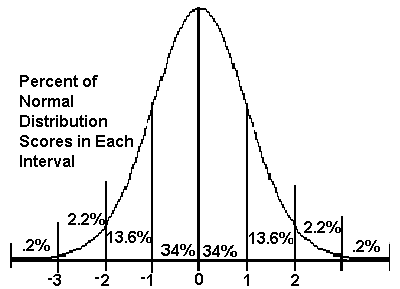
Image

From the attached image, you can say that 68% of the class received a score within 1 standard deviation of the mean i.e. 76

Statement 1:

8 students score 96 or higher.

This doesn't help us determine the standard deviation, and thus we cannot determine the failing grade.

INSUFFICIENT

Statement 2:

Standard deviation = 10 points

This means that 68% of the class was from 66 to 86 points

This leaves 32%

Of this 16% are below 66 and 16% are above 86.

Therefore based on the info that bottom 16% fail, the failing score is 66.

SUFFICIENT

Pick B
~Abhay

Believe those who are seeking the truth. Doubt those who find it. -- Andre Gide
Join the discussion

by kvcpk » Tue Jun 29, 2010 11:01 am
Are you sure that this is a GMAT Question?

Can you please mention the source.

Thank you!!
Join the discussion

by gmatrant » Sat Jul 03, 2010 12:06 am
albatross - How did you split 34% , then 13.6% so on.. or is this graph given as part of the question?
if not from the question how did you generate the distribution graph.
Join the discussion

by Testluv » Sat Jul 03, 2010 12:09 am
This question requires knowledge of the characteristics of a normal distribution.
--And for that this question is testing concepts that fall outside the scope of the GMAT.
Kaplan Teacher in Toronto
Join the discussion

by albatross86 » Sat Jul 03, 2010 12:48 am
Testluv wrote:
This question requires knowledge of the characteristics of a normal distribution.
--And for that this question is testing concepts that fall outside the scope of the GMAT.
Heh, like I said, this topic is surrounded by controversy. I've heard varying opinions, and rather than waste time debating whether it's fair game or not, I thought I might as well remember that 68% of the set lies within 1 s.d. :)

But, coming from you, I'm reassured that it probably won't be tested, thanks.
~Abhay

Believe those who are seeking the truth. Doubt those who find it. -- Andre Gide
Join the discussion

by albatross86 » Sat Jul 03, 2010 12:56 am
gmatrant wrote:albatross - How did you split 34% , then 13.6% so on.. or is this graph given as part of the question?
if not from the question how did you generate the distribution graph.
This is a generic "normal distribution" graph. I've seen 4 or 5 questions from varying sources (including Grockit) that required me to know that a normal distribution has the properties displayed in that graph. This graph wasn't provided in the question in any of those instances, I took it off the net.

I strongly believe that out-of-scope questions should be ignored. However, as for whether this is within the scope of the GMAT or not, I have heard varying opinions and can't be bothered anymore. It's a lot easier to just remember the "68%" criterion and move on. :D

In short, don't bother too much with it, whatever you decide.
~Abhay

Believe those who are seeking the truth. Doubt those who find it. -- Andre Gide
Join the discussion

by sanju09 » Sat Jul 03, 2010 1:05 am
See what Brian Fruchey has to say...

https://www.beatthegmat.com/mba/2009/08/ ... -deviation
The mind is everything. What you think you become. -Lord Buddha


Sanjeev K Saxena
Quantitative Instructor
The Princeton Review - Manya Abroad
Lucknow-226001

www.manyagroup.com
Join the discussion

by gmatmachoman » Sat Jul 03, 2010 2:48 am
kvcpk wrote:Are you sure that this is a GMAT Question?

Can you please mention the source.

Thank you!!
Praveen bhai,
I am sure u can see like this one on GMAT...it comes under 34:14:2 statistical rule.

basically the normal distribution curve is divided in to 6sigma ( 3 on one side and 3 on other side of the mean value)

Abhay has given the distribution curve properly and the explanation hencefoth is also neat!
Join the discussion

by kvcpk » Sat Jul 03, 2010 4:30 am
gmatmachoman wrote:
kvcpk wrote:Are you sure that this is a GMAT Question?

Can you please mention the source.

Thank you!!
Praveen bhai,
I am sure u can see like this one on GMAT...it comes under 34:14:2 statistical rule.

basically the normal distribution curve is divided in to 6sigma ( 3 on one side and 3 on other side of the mean value)

Abhay has given the distribution curve properly and the explanation hencefoth is also neat!
Thanks for the confirmation Buddy!! ;)
Join the discussion

by gmatmachoman » Sat Jul 03, 2010 4:50 am
Testluv wrote:
This question requires knowledge of the characteristics of a normal distribution.
--And for that this question is testing concepts that fall outside the scope of the GMAT.

Ohhhhhhh..Dada has said No..so it means No only...agreed... I am taking my wrds back!!
Join the discussion

by kvcpk » Sat Jul 03, 2010 5:45 am
gmatmachoman wrote:
Testluv wrote:
This question requires knowledge of the characteristics of a normal distribution.
--And for that this question is testing concepts that fall outside the scope of the GMAT.

Ohhhhhhh..Dada has said No..so it means No only...agreed... I am taking my wrds back!!
hmmm.. me too ;)
Join the discussion