AbeNeedsAnswers wrote:
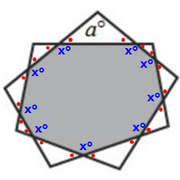
The figure shown above consists of a shaded 9-sided polygon and 9 unshaded isosceles triangles.For each isosceles triangle,the longest side is a side of the shaded polygon and the two sides of equal length are extensions of the two adjacent sides of the shaded polygon.What is the value of a ?
A. 100
B. 105
C. 110
D. 115
E. 120
A
Although the 9-sided polygon is NOT a regular polygon (with equal angles and equal sides), we CAN show that the angles are all equal.
The key here is that each of the unshaded triangles is an
isosceles triangle.
So, for example, we know that the two angles with the red dots are equal.
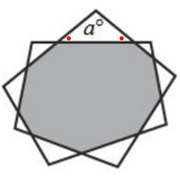
Since the next angle over is opposite the angle with the red dot, we know that that angle is also equal to the other two angles (see the diagram below)
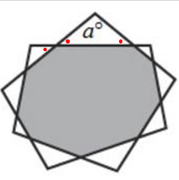
Since the next triangle is ISOSCELES, we know that its other angle is equal to the first (see the diagram below)
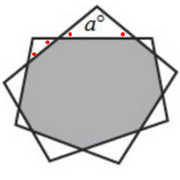
We can continue applying the same rules and logic to see that all of the red dotted angles are all equal.
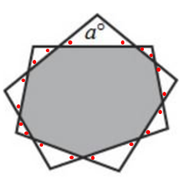
Next, if all of the red-dotted angles are equal, then all of the angles denoted with
x are all equal, since each of those angles is on a line with the red-dotted angle.
To determine the value of x, we'll use the following rule:
the sum of the angles in an n-sided polygon = (n - 2)(180º)
So, in a 9-sided polygon, the sum of ALL 9 angles = (9 - 2)(180º) = (7)(180º)
So, EACH individual angle = (7)(180º)/9 =
140º
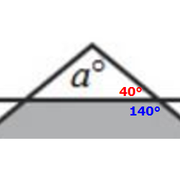
Also, since the red-dotted angle is on the line with the
140º, the red-dotted angle =
40º
Let's add this information to the diagram below:
Since the unshaded triangle is isosceles, the other angle is also
40º
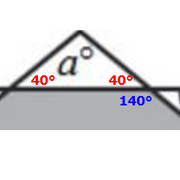
Since all three angles in the triangle must add to 180º, the last remaining angle (aº) must be 100º
Answer:
A























