Problem from mba.com practice test 1

This topic has expert replies
Newbie | Next Rank: 10 Posts
Posts: 8
Joined: Sun Mar 30, 2008 6:43 am
Thanked: 1 times

Problem from mba.com practice test 1

by ksutthi » Sat Jul 05, 2008 3:22 am
Can anyone help me solve this question? I don't seem to be able to derive the answer.

In the xy-plane, at what two points does the graph of y = (x+a)(x+b) intersect the x-axis?

(1) a+b = -1
(2) The graph intersects the y-axis at (0,-6)

Many thanks.
Source: — Data Sufficiency |

Junior | Next Rank: 30 Posts
Posts: 18
Joined: Sat Jul 05, 2008 5:40 pm
Thanked: 2 times

by ed09 » Sat Jul 05, 2008 9:28 pm
I dare to say that the answer is C.

Below is my solution.

Rewrite the equation in form of quadratic
y=x^2+(a+b)x+ab

0=x^2+(a+b)x+ab - real solutions of this equation are x-coordinates of points where the graph intersects the x-axis.

(1)
a+b=-1 => x^2-x+ab=0
a+b=-1 - does not give enough data to be sure about ab
INSUFFICIENT

(2) (0,6) - this is one root
0=x^2+(a+b)x+ab; (x-6)(x+z)=0; x2+zx-6x-6z=0; x2+(z-6)x-6z=0
there is no enough data to solve this equation further
INSUFFICIENT

(3) COMBINE
from (2) x2+(z-6)x-6z=0
from (1) 0=x^2+(a+b)x+ab; a+b=-1
=>(a+b)=z-6=-1 => z=5 => -6z=-30
hence the equation sought is x2-x-30=0 or (x-6)(x+5)=0
thus, roots of (0,6) and (0,-5) are coordinates of points where the graph intersects the x-axis.
SUFFICIENT

I'll appreciate someone, who find a mistake in my solution or show a shorter way.
Best!

Newbie | Next Rank: 10 Posts
Posts: 8
Joined: Sun Mar 30, 2008 6:43 am
Thanked: 1 times

by ksutthi » Sat Jul 05, 2008 10:44 pm
ed09 - yes, you got it. the answer is C.

Many thanks!

Junior | Next Rank: 30 Posts
Posts: 26
Joined: Thu Jun 19, 2008 5:27 am
Thanked: 4 times

by Carol » Wed Jul 09, 2008 12:15 pm
ed09

since you got it, could you try to explain your reasoning, elaborate it bit longer and clearly.

I didn't quite understood your explanation regarding the 2nd sentence.


Many thanks

Master | Next Rank: 500 Posts
Posts: 106
Joined: Sun Feb 17, 2008 10:09 pm
Thanked: 3 times

by ksh » Thu Jul 10, 2008 3:39 am
ed09 wrote:I dare to say that the answer is C.

Below is my solution.

Rewrite the equation in form of quadratic
y=x^2+(a+b)x+ab

0=x^2+(a+b)x+ab - real solutions of this equation are x-coordinates of points where the graph intersects the x-axis.

(1)
a+b=-1 => x^2-x+ab=0
a+b=-1 - does not give enough data to be sure about ab
INSUFFICIENT

(2) (0,6) - this is one root
0=x^2+(a+b)x+ab; (x-6)(x+z)=0; x2+zx-6x-6z=0; x2+(z-6)x-6z=0
there is no enough data to solve this equation further
INSUFFICIENT

(3) COMBINE
from (2) x2+(z-6)x-6z=0
from (1) 0=x^2+(a+b)x+ab; a+b=-1
=>(a+b)=z-6=-1 => z=5 => -6z=-30
hence the equation sought is x2-x-30=0 or (x-6)(x+5)=0
thus, roots of (0,6) and (0,-5) are coordinates of points where the graph intersects the x-axis.
SUFFICIENT

I'll appreciate someone, who find a mistake in my solution or show a shorter way.
Best!
Hi ed09

I think there is an alternative to your solution

Stem 1. a+b=-1, plugging this the given equation x^2+(a+b)x+ab becomes x^2-x+ab. This is insufficient as we dont know the value of ab

Stem 2. It intercept y axis at (0,6), which means
6=0+0+ab or ab=6--- insufficient

Now combining 1+2 we get
x^2-x+6=0 which has solutions. so, sufficient

Hence C.

Junior | Next Rank: 30 Posts
Posts: 18
Joined: Sat Jul 05, 2008 5:40 pm
Thanked: 2 times

by ed09 » Fri Jul 11, 2008 1:05 pm
Hi ksh, or Rising GMAT Star, ;)

I truly appreciate your remark, since it correctly points to my mistake.
I was definitely wrong in solving the second statement.

Indeed, the statement "The graph intersects the y-axis at (0,-6)"
means that x=0, but y=-6. Therefore, after substitution of these variables into the initial equation we get -6=0^2+(a+b)0+ab
That means -6=ab.
This also doesn't let us to find the second point of the graph's intersecting the x-axis.
That is the second statement is still INSUFFICIENT.

However, when we combine the statements and substitute their results
a+b=-1
ab=-6
in the original equation we get
0=x^2+(-1)x+(-6)
That is x^2-x-6=0 or (x+2)(x-3)=0. As a result of solving this we can find two roots: x=-2 or x=3.
Hence, the points of (-2,0) and (3,0) are those which we are asked about.
SUFFICIENT

The answer is still C.

Sorry for my pointing to that, but I just think it's worth to notice that your last equation and the remark about it are not accurate.
The equation of x^2-x+6=0 has no real solutions, and so we can't apply them to the xy-plane given.
I believe, you've realized this already.

Anyway, thanks a lot, and good luck on the test!

User avatar
Newbie | Next Rank: 10 Posts
Posts: 6
Joined: Sat Jan 28, 2012 2:58 pm
Thanked: 1 times

by mathlete1 » Sun Jan 29, 2012 8:09 pm
Ksh and ed09....the coordinate given for #2 is (0,-6), not (0,6)...
ksh wrote:
ed09 wrote:I dare to say that the answer is C.

Below is my solution.

Rewrite the equation in form of quadratic
y=x^2+(a+b)x+ab

0=x^2+(a+b)x+ab - real solutions of this equation are x-coordinates of points where the graph intersects the x-axis.

(1)
a+b=-1 => x^2-x+ab=0
a+b=-1 - does not give enough data to be sure about ab
INSUFFICIENT

(2) (0,6) - this is one root
0=x^2+(a+b)x+ab; (x-6)(x+z)=0; x2+zx-6x-6z=0; x2+(z-6)x-6z=0
there is no enough data to solve this equation further
INSUFFICIENT

(3) COMBINE
from (2) x2+(z-6)x-6z=0
from (1) 0=x^2+(a+b)x+ab; a+b=-1
=>(a+b)=z-6=-1 => z=5 => -6z=-30
hence the equation sought is x2-x-30=0 or (x-6)(x+5)=0
thus, roots of (0,6) and (0,-5) are coordinates of points where the graph intersects the x-axis.
SUFFICIENT

I'll appreciate someone, who find a mistake in my solution or show a shorter way.
Best!
Hi ed09

I think there is an alternative to your solution

Stem 1. a+b=-1, plugging this the given equation x^2+(a+b)x+ab becomes x^2-x+ab. This is insufficient as we dont know the value of ab

Stem 2. It intercept y axis at (0,6), which means
6=0+0+ab or ab=6--- insufficient

Now combining 1+2 we get
x^2-x+6=0 which has solutions. so, sufficient

Hence C.

GMAT/MBA Expert

User avatar
GMAT Instructor
Posts: 273
Joined: Tue Sep 21, 2010 5:37 am
Location: Durham, NC
Thanked: 154 times
Followed by:74 members
GMAT Score:770

by Whitney Garner » Tue Jan 31, 2012 11:43 am
ksutthi wrote:Can anyone help me solve this question? I don't seem to be able to derive the answer.

In the xy-plane, at what two points does the graph of y = (x+a)(x+b) intersect the x-axis?

(1) a+b = -1
(2) The graph intersects the y-axis at (0,-6)

Many thanks.
Hi ksutthi!

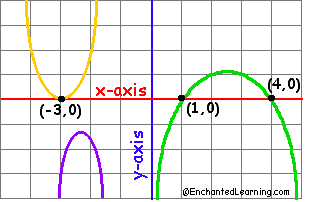
The real shortcut here is understanding what "solutions" to a quadratic actually mean. Let's think for a moment on a topic that is actually a bit past the scope of the GMAT - the physical shape of a quadratic equation...it is a parabola. And in the world of parabolas, we often want to think about how many times they cross the X axis. From the images below, you can see that a parabola can cross the x-axis one-time, 2-times or 0-times.
Image

Okay, pretty neeto but so what right?? Well, the fact is that we like to think of these x-intercepts because they are all of the places where the Y value is 0. so when the formula y = ax^2 + bx + c becomes 0 = ax^2 + bx + c... so these are the values of X that would SOLVE that equation. But we know how to solve quadratics when they are =0 right?? We factor and then set each piece to 0. HOLD ON!! This means that the "solutions" of a quadratic are actually the x-intercepts of the quadratic/parabola!!

So guess what, the authors of the question have actually done most of the work for you. They already factored the X side into (x+a)(x+b), so to find x-intercepts, we just need to set the Y=0. This means that the quadratic will cross the x-axis at x=-a and x=-b. We just need to find those values!

Stm(1) a+b=-1

This just means that our 2 intercepts will sum to -1, but that doesn't tell us what their specific values are... For example: 8 and -9 or -4 and 3 would both work... [spoiler]Insufficient!![/spoiler]

Stm(2) The graph intersects the y-axis at (0,-6)
This means that when X=0, Y=-6. Let's plug that in:

-6 = (0+a)(0+b)
-6=ab

There are lots of combinations of a & b that will result in a product of -6 so [spoiler]INSUFFICIENT!![/spoiler]

TOGETHER
So now we have the following 2 equations:

a+b=-1
ab=-6

It would seem as if these 2 equations would be incompatible to actually solve for a and b individually, and you would be correct, BUT we don't really care what a is exactly, or what b is exactly - I'll show you what I mean. Let's solve the equation a+b=-1 for a and substitute into the second equation:

a=-1-b

(-1-b)(b)=-6
-b-b^2=-6
6 - b - b^2 = 0
(3+b)(2-b)=0
b=-3 or b=2

But would this be insufficient?? Well, let's check the values for a that correspond to these b values. We can use a=-1-b to solve:

when b=-3, a=-1-(-3)=-1+3=2
when b=2, a=-1-2=-3

So notice what happens, the a and b just swap values. But since we only care about the intercepts, we don't really care if they are (-3,0) & (2,0) or if they are (2,0) & (-3,0). The notation of a and b is just arbitrary! [spoiler]SUFFICIENT!![/spoiler]

Hope this helps!
:)
Whit

ASIDE: I talked about the number of times a parabola hits the x-axis so here is a fun tidbit of added info!! We determine the number of intercepts by the number of solutions:
- perfect squares (x+a)^2 only touch the x-axis once because their 2 solutions are equal
- typical factored quadratics will cross 2 times because they have 2 unique solutions
- un-factorable quadratics will NOT cross the x-axis because they have NO solution (x^2+a^2) for example)
Last edited by Whitney Garner on Wed Feb 01, 2012 3:47 pm, edited 1 time in total.
Whitney Garner
GMAT/GRE/EA Instructor & Anxiety/Accommodations Coach
www.whitneygarner.com

Contributor to Beat The GMAT!

Math is a lot like love - a simple idea that can easily get complicated :heart-eyes:

User avatar
Newbie | Next Rank: 10 Posts
Posts: 6
Joined: Sat Jan 28, 2012 2:58 pm
Thanked: 1 times

by mathlete1 » Wed Feb 01, 2012 3:29 pm
Whitney Garner wrote:
ksutthi wrote:Can anyone help me solve this question? I don't seem to be able to derive the answer.

In the xy-plane, at what two points does the graph of y = (x+a)(x+b) intersect the x-axis?

(1) a+b = -1
(2) The graph intersects the y-axis at (0,-6)

Many thanks.
Hi ksutthi!

The real shortcut here is understanding what "solutions" to a quadratic actually mean. Let's think for a moment on a topic that is actually a bit past the scope of the GMAT - the physical shape of a quadratic equation...it is a parabola. And in the world of parabolas, we often want to think about how many times they cross the X axis. From the images below, you can see that a parabola can cross the x-axis one-time, 2-times or 0-times.

Image

Okay, pretty neeto but so what right?? Well, the fact is that we like to think of these x-intercepts because they are all of the places where the Y value is 0. so when the formula y = ax^2 + bx + c becomes 0 = ax^2 + bx + c... so these are the values of X that would SOLVE that equation. But we know how to solve quadratics when they are =0 right?? We factor and then set each piece to 0. HOLD ON!! This means that the "solutions" of a quadratic are actually the x-intercepts of the quadratic/parabola!!

So guess what, the authors of the question have actually done most of the work for you. They already factored the X side into (x+a)(x+b), so to find x-intercepts, we just need to set the Y=0. This means that the quadratic will cross the x-axis at x=-a and x=-b. We just need to find those values!

Stm(1) a+b=-1

This just means that our 2 intercepts will sum to -1, but that doesn't tell us what their specific values are... For example: 8 and -9 or -4 and 3 would both work... [spoiler]Insufficient!![/spoiler]

Stm(2) The graph intersects the y-axis at (0,-6)
This means that one of the intercepts is -6, so -a=-6 or -b=-6, but we don't know the other value...[spoiler]INSUFFICIENT!![/spoiler]

TOGETHER
So we know that one of the intercepts is -6 now. But we don't know which one, does that matter?? Actually, no. We know that the sum of the intercepts must be -1, so -6+what = -1... 5! So we know that the other intercept is 5. Does it matter if a=5, b=-6 or a=-6, b=5?? Did the question specifically ask "What is A?" Nope!! They just wanted the intercepts, and they are (0,5) and (0,-6)...Good Enough!! [spoiler]SUFFICIENT!![/spoiler]

Hope this helps!
:)
Whit

ASIDE: I talked about the number of times a parabola hits the x-axis so here is a fun tidbit of added info!! We determine the number of intercepts by the number of solutions:
- perfect squares (x+a)^2 only touch the x-axis once because their 2 solutions are equal
- typical factored quadratics will cross 2 times because they have 2 unique solutions
- un-factorable quadratics will NOT cross the x-axis because they have NO solution (x^2+a^2) for example)

Whitney,

Wait a second...isn't the problem asking about the x-intercepts????? You wrote (0,5) and (0, -6) are the solutions. Those are y-intercepts!!!

GMAT/MBA Expert

User avatar
GMAT Instructor
Posts: 273
Joined: Tue Sep 21, 2010 5:37 am
Location: Durham, NC
Thanked: 154 times
Followed by:74 members
GMAT Score:770

by Whitney Garner » Wed Feb 01, 2012 3:41 pm
mathlete1 wrote: Whitney,

Wait a second...isn't the problem asking about the x-intercepts????? You wrote (0,5) and (0, -6) are the solutions. Those are y-intercepts!!!
GREAT Catch!! Guess I was just not paying attention - I'll fix the post to correct this! The answer is still the same, just different intercepts!

:)
Whit
Whitney Garner
GMAT/GRE/EA Instructor & Anxiety/Accommodations Coach
www.whitneygarner.com

Contributor to Beat The GMAT!

Math is a lot like love - a simple idea that can easily get complicated :heart-eyes:

User avatar
Legendary Member
Posts: 934
Joined: Tue Nov 09, 2010 5:16 am
Location: AAMCHI MUMBAI LOCAL
Thanked: 63 times
Followed by:14 members

by [email protected] » Sun Feb 19, 2012 4:39 am
You know what, a great explanation given by Whitney, thanks a lot!!!...
Okay, pretty neeto but so what right?? Well, the fact is that we like to think of these x-intercepts because they are all of the places where the Y value is 0. so when the formula y = ax^2 + bx + c becomes 0 = ax^2 + bx + c... so these are the values of X that would SOLVE that equation. But we know how to solve quadratics when they are =0 right?? We factor and then set each piece to 0. HOLD ON!! This means that the "solutions" of a quadratic are actually the x-intercepts of the quadratic/parabola!!

So guess what, the authors of the question have actually done most of the work for you. They already factored the X side into (x+a)(x+b), so to find x-intercepts, we just need to set the Y=0. This means that the quadratic will cross the x-axis at x=-a and x=-b. We just need to find those values!

Stm(1) a+b=-1
This just means that our 2 intercepts will sum to -1, but that doesn't tell us what their specific values are... For example: 8 and -9 or -4 and 3 would both work... Insufficient!!

Stm(2) The graph intersects the y-axis at (0,-6)
This means that when X=0, Y=-6. Let's plug that in:

-6 = (0+a)(0+b)
-6=ab

There are lots of combinations of a & b that will result in a product of -6 so INSUFFICIENT!!

TOGETHER
So now we have the following 2 equations:

a+b=-1
ab=-6

It would seem as if these 2 equations would be incompatible to actually solve for a and b individually, and you would be correct, BUT we don't really care what a is exactly, or what b is exactly - I'll show you what I mean. Let's solve the equation a+b=-1 for a and substitute into the second equation:

a=-1-b

(-1-b)(b)=-6
-b-b^2=-6
6 - b - b^2 = 0
(3+b)(2-b)=0
b=-3 or b=2

But would this be insufficient?? Well, let's check the values for a that correspond to these b values. We can use a=-1-b to solve:

when b=-3, a=-1-(-3)=-1+3=2
when b=2, a=-1-2=-3

So notice what happens, the a and b just swap values. But since we only care about the intercepts, we don't really care if they are (-3,0) & (2,0) or if they are (2,0) & (-3,0). The notation of a and b is just arbitrary! SUFFICIENT!!

Hope this helps!
IT IS TIME TO BEAT THE GMAT

LEARNING, APPLICATION AND TIMING IS THE FACT OF GMAT AND LIFE AS WELL... KEEP PLAYING!!!

Whenever you feel that my post really helped you to learn something new, please press on the 'THANK' button.

User avatar
Legendary Member
Posts: 934
Joined: Tue Nov 09, 2010 5:16 am
Location: AAMCHI MUMBAI LOCAL
Thanked: 63 times
Followed by:14 members

by [email protected] » Sun Feb 19, 2012 4:40 am
By the way what is the source of this question...ksutthi
IT IS TIME TO BEAT THE GMAT

LEARNING, APPLICATION AND TIMING IS THE FACT OF GMAT AND LIFE AS WELL... KEEP PLAYING!!!

Whenever you feel that my post really helped you to learn something new, please press on the 'THANK' button.

















