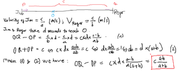
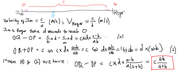
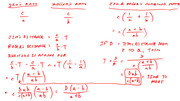
Jim takes a seconds to swim c meters at a constant rate from point P to point Q in a pool. Roger, who is faster than Jim, can swim the same distance in b seconds at a constant rate. If Jim leaves point P the same time that Roger leaves point Q, how many fewer meters will Jim have swum than Roger when the two swimmers pass each other?
A) c(b-a)/ a+b
B) c(a-b)/a+b
C) c(a+b)/a-b
D) ab(a-b)/a+b
E) ab(b-a)/a+b
Since there are variables in the answer choices, we can plug in values.
Let c = 30 meters, a = 3 seconds, and b = 2 seconds.
Jim's rate = d/t = 30/3 = 10 meters per second.
Roger's rate = d/t = 30/2 = 15 meters per second.
Jim's rate : Roger's rate = 10:15 = 2:3 = 12:18.
Implication: for every 12 meters that Jim swims, Roger swims 18 meters.
Thus, when the two travel the 30 meters between them, Roger's distance - Jim's distance = 18-12 = 6 meters. This is our target.
Now we plug c=30, a=3 and b=2 into the answers to see which yields our target of 6.
Only
B works:
c(a-b)/(a+b) = 30(3-2)/(3+2) = 6.
The correct answer is
B.
Private tutor exclusively for the GMAT and GRE, with over 20 years of experience.
Followed here and elsewhere by over 1900 test-takers.
I have worked with students based in the US, Australia, Taiwan, China, Tajikistan, Kuwait, Saudi Arabia -- a long list of countries.
My students have been admitted to HBS, CBS, Tuck, Yale, Stern, Fuqua -- a long list of top programs.
As a tutor, I don't simply teach you how I would approach problems.
I unlock the best way for YOU to solve problems.
For more information, please email me (Mitch Hunt) at
[email protected].
Student Review #1
Student Review #2
Student Review #3