Poster, can you clarify where you found this? I don't recognize this problem, and I can't find it in any of our materials. I think it's unlikely that this is actually a Manhattan Prep question.
Ceilidh Erickson
EdM in Mind, Brain, and Education
Harvard Graduate School of Education
I think A is the correct answer.
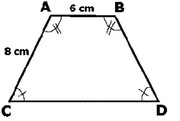
For statement 1, we can draw the height from A to line CD, since the angle A is 120, we can get the height of the trapezoid, thus we can calculate the area.
For statement 2, we only know the perimeter is 36, thus BD +CD=36-AB-AC=36-6-8=22. However, there is no way to find BD and CD, thus this statement is insufficient.
Statement 1
Angle A = 120 degree
Angle A = Angle B = 120 degree
Angle c = Angle D = 60 degree
AB = 60 degree
AC = BD = 8cm
AB = 6cm
A straight line from A to a point E on CD will form right angled triangle AEC
A straight line from B to a point F on CD will form right angle triangle BFD
AB = EF = 6cm
CD = CE + EF + FD
with pythagoras theorem on triangle AEC and BFD we will get the value of CE, FD and heights.
Therefore we can find the area of trapezoid shown statement 1 is SUFFICIENT
Statement 2
Perimeter of trapezoid ABCD = 36
Perimeter = AC + AB + BD + CD
AC = BD = 8cm and with the formular for perimeter we will get the value of CD
A straight line from A to point E on CD will form a right angle triangle AEC
A straight line from B to a point F on CD will form a right angle triangle BFD
and with these triangle, we can find the interior angle of the trapezoid as well as the height with SOH CAH TOA
Therefore, we will find the area of trapezoid shown with height AB and CD, hence statement 2 is INSUFFICIENT,
$$answer\ is\ option\ D$$