
BREAKING: Target Test Prep releases Brand New 2026 On Demand GMAT prep course

Redeem

GMAT time strategies

We invite all community contributors to share resources that are deemed to help students beat the GMAT. We've created individual threads to match the main topics, so please select the best fit for your content carefully.
Expert replies
by DustinPatton15 » Mon Feb 27, 2017 11:16 am
Hello,

I recently took my second GMAT practice test using the GMAT PREP software and was very disappointed with my score of a 490. It is the exact same score I got the first time taking the test without studying for 2 months. I realized my poor score in the quant section came down to time management, as I had 5 minutes to answer the last 10 question of the quant section, getting 7 of the questions incorrect.

I would greatly appreciate any helpful tips or insights for managing my time better.

Thanks,
Dustin
Join the discussion
Source: — Helpful Resources |

GMAT time strategies

by Brent@GMATPrepNow » Mon Feb 27, 2017 12:20 pm
Hi Dustin,

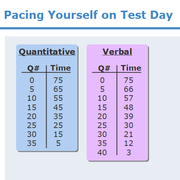
I suggest that you manage your time in batches of 5 questions. To that end, you can use the following Milestone Charts to keep you on track:
Image
These times are easily remembered so you can quickly jot them on your noteboard on test day.

This (and much more) is covered in our GMAT time management video at https://www.gmatprepnow.com/module/gener ... es?id=1244

Cheers,
Brent
Brent Hanneson - Creator of GMATPrepNow.com
Image
Join the discussion

GMAT time strategies

by [email protected] » Mon Feb 27, 2017 1:20 pm
Hi Dustin,

Pacing issues do not exist on their own - they're the results of OTHER issues. Thus, it might help if you create a new thread in the GMAT Strategy Forum here...

https://www.beatthegmat.com/gmat-strategy-f3.html

... and go into a bit more detail about how you've been studying and your goals.

GMAT assassins aren't born, they're made,
Rich
Contact Rich at [email protected]
Image
Join the discussion

by AlexBarret » Thu May 11, 2017 11:39 am
DustinPatton15 wrote:Hello,

I recently took my second GMAT practice test using the GMAT PREP software and was very disappointed with my score of a 490. It is the exact same score I got the first time taking the test without studying for 2 months. I realized my poor score in the quant section came down to time management, as I had 5 minutes to answer the last 10 question of the quant section, getting 7 of the questions incorrect.

I would greatly appreciate any helpful tips or insights for managing my time better.

Thanks,
Dustin
Hi, Dustin!
It`s the one of the most difficult task to manage our time. You need to have a strong will and tobe very motivated. Divide youe day into a small sections for every task you have to do, and write down into a note. I advice you to have a little organiser for such kind of the work. For example, from 1 to 2 o`clock you have to do several exercises. And you have to understand there is no another way, only this one. Good luck for you!) I believe you did it.
Join the discussion

by Matt@VeritasPrep » Wed Jul 05, 2017 12:04 am
Knowing when to punt a question is important too - don't assume you'll solve everything, or that time spent on a problem is necessarily time well spent!
Join the discussion

by ceilidh.erickson » Sat Nov 18, 2017 2:54 pm
DustinPatton15 wrote:Hello,

I recently took my second GMAT practice test using the GMAT PREP software and was very disappointed with my score of a 490. It is the exact same score I got the first time taking the test without studying for 2 months. I realized my poor score in the quant section came down to time management, as I had 5 minutes to answer the last 10 question of the quant section, getting 7 of the questions incorrect.

I would greatly appreciate any helpful tips or insights for managing my time better.

Thanks,
Dustin
This is my preferred timing strategy: https://www.manhattanprep.com/gmat/blog ... tch-paper/

If you segment your yellow pad into quadrants and label them with your timing benchmarks, you'll know exactly when to look at the clock, and exactly what you should see when you do.
Ceilidh Erickson
EdM in Mind, Brain, and Education
Harvard Graduate School of Education
Join the discussion


















