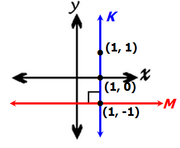
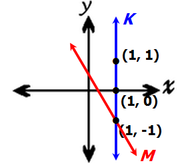
Vincen wrote:In xy plane, line k passes through (1,1) and m through (1, -1). Are lines k and m perpendicular?
(1) k and m intersect at (1, -1)
(2) k intersects x -axis at (1, 0)
Statements combined:
Only one fact is known about line m:
It passes through (1, -1).
Implication:
Line m can have any ANY SLOPE.
Thus, it cannot be determined whether line m is perpendicular to line k.
INSUFFICIENT.
The correct answer is
E.
Both statements implies that k is a vertical line? Am I wrong? Why aren't they sufficient?
Each statement implies that line k is vertical.
If line m is HORIZONTAL, then it WILL be perpendicular to line k, with the result that the answer to the question stem is YES.
If line m is NOT horizontal, then it will NOT be perpendicular to line k, with the result that the answer to the question stem is NO.
Since the answer is YES in the first case but NO in the second case, the two statements combined are INSUFFICIENT.
Private tutor exclusively for the GMAT and GRE, with over 20 years of experience.
Followed here and elsewhere by over 1900 test-takers.
I have worked with students based in the US, Australia, Taiwan, China, Tajikistan, Kuwait, Saudi Arabia -- a long list of countries.
My students have been admitted to HBS, CBS, Tuck, Yale, Stern, Fuqua -- a long list of top programs.
As a tutor, I don't simply teach you how I would approach problems.
I unlock the best way for YOU to solve problems.
For more information, please email me (Mitch Hunt) at
[email protected].
Student Review #1
Student Review #2
Student Review #3