=>
Forget conventional ways of solving math questions. For DS problems, the VA (Variable Approach) method is the quickest and easiest way to find the answer without actually solving the problem. Remember that equal numbers of variables and independent equations ensure a solution.
Visit
https://www.mathrevolution.com/gmat/lesson for details.
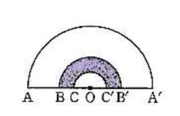
Since we have three semi-circles, we have 3 variables and 0 equations, E is most likely to be the answer. So, we should consider conditions 1) & 2) together first. After comparing the number of variables and the number of equations, we can save time by considering conditions 1) & 2) together first.
Conditions 1) & 2)
Assume r
1, r
2 and r
3 are radii of the circles with diameters CC', BB' and AA', respectively.
We have r
2 = 2r
1 and r
3 = 2r
2 = 4r
1 from conditions 1) & 2).
Then the shared area is πr
2^2/2 - πr
1^2/2 = 4Ï€r
1^2/2 - πr
1^2/2 = (3/2)Ï€r
1^2.
However, since we don't know the value of r
1, we can't determine r
1.
So, both conditions together do not yield a unique solution and they are not sufficient.
Therefore, E is the answer.
Answer: E
In cases where 3 or more additional equations are required, such as for original conditions with "3 variables", or "4 variables and 1 equation", or "5 variables and 2 equations", conditions 1) and 2) usually supply only one additional equation. Therefore, there is an 80% chance that E is the answer, a 15% chance that C is the answer, and a 5% chance that the answer is A, B or D. Since E (i.e. conditions 1) & 2) are NOT sufficient, when taken together) is most likely to be the answer, it is generally most efficient to begin by checking the sufficiency of conditions 1) and 2), when taken together. Obviously, there may be occasions when the answer is A, B, C or D.