BREAKING: Target Test Prep releases Brand New 2026 On Demand GMAT prep course

Redeem

Target Test Prep · GMAT

Choose how you want to prepare

Learn live with an expert or move at your own pace. Every option includes the complete TTP study system.

★★★★★5.0559 reviews
GMATLiveTeach 7 seats left
Chris Peckover
NEXT LIVE COHORT

Oct 13 to Jan 7, 2027

with Chris Peckover

Schedule
Tue, Thu · 8:00 to 10:00 PM ET
Included
40 live hours + 6 months of GMAT OnDemand
  • Live instruction and real-time questions
  • Class recordings and assigned practice
View class & enroll
Limited cohort · enrollment openTarget Test Prep
EALiveTeach 5 seats left
Logan Thompson
EXECUTIVE ASSESSMENT

Sep 6 to Dec 6, 2026

with Logan Thompson

Schedule
Sun · 9:30 AM to 12:30 PM ET
Included
40 hours of live online classes plus six months of access to the complete TTP EA OnDemand course.
  • 165+ EA Score Guarantee
  • 4,100+ Quant, Verbal, and Integrated Reasoning practice questions
  • 400+ hours of in-depth video lessons
  • 3,000+ step-by-step video solutions
View EA class & enroll
Limited cohort · enrollment openTarget Test Prep
GMATOnDemand Start anytime
SELF-PACED MASTERCLASS

Target Test Prep GMAT OnDemand

Complete access from day one. Study on your schedule.

715+ score guarantee
$0to start then $127/mo
  • Personalized study plan and analytics
  • Thousands of lessons and practice questions

Compare the format, schedule, and included access before enrolling. Prices and seat counts shown reflect the supplied offer details.

OG-2nd Edition - Question 114 & 134

Expert replies
by shanice » Sun Aug 05, 2012 8:11 pm
1)Salesperson A's compensation for any week is $360 plus 6 percent of the portion of A's total sales above $1,000 for that week. Salesperson B's compensation for any week is 8 percent of B's total sales for that week. For what amount of total weekly sales would both salespeople earn the same compensation?

(A)$21,000
(B)$18,000
(C)$15,000
(D)$4,500
(E)$4,000

Answer is C.

2)If d>0 and 0<1-c/d<1, which of the following must be true?

I . c>0
II . c/d<1
III. c^2+d^2>1

(A)I only
(B)II only
(C)I and II only
(D)II and III only
(E)I,II and III


Answer is C.

Please help me with step by step explanation.

Thank you.
Join the discussion
Source: — Problem Solving |

by Anurag@Gurome » Sun Aug 05, 2012 8:24 pm
shanice wrote:1)Salesperson A's compensation for any week is $360 plus 6 percent of the portion of A's total sales above $1,000 for that week. Salesperson B's compensation for any week is 8 percent of B's total sales for that week. For what amount of total weekly sales would both salespeople earn the same compensation?

(A)$21,000
(B)$18,000
(C)$15,000
(D)$4,500
(E)$4,000

Answer is C.

Please help me with step by step explanation.

Thank you.
Let the total weekly sales = $S (here both salespersons A and B earn the same amount)
Then 360 + 6% of (S - 1000) = 8% of S
360 + 0.06(S - 1000) = 0.08S
360 + 0.06S - 60 = 0.08S
0.02S = 300
S = [spoiler]$15,000[/spoiler]

The correct answer is C.
Anurag Mairal, Ph.D., MBA
GMAT Expert, Admissions and Career Guidance
Gurome, Inc.
1-800-566-4043 (USA)

Join Our Facebook Groups
GMAT with Gurome
https://www.facebook.com/groups/272466352793633/
Admissions with Gurome
https://www.facebook.com/groups/461459690536574/
Career Advising with Gurome
https://www.facebook.com/groups/360435787349781/
Join the discussion

by Anurag@Gurome » Sun Aug 05, 2012 8:30 pm
shanice wrote: 2)If d>0 and 0<1-c/d<1, which of the following must be true?

I . c>0
II . c/d<1
III. c^2+d^2>1

(A)I only
(B)II only
(C)I and II only
(D)II and III only
(E)I,II and III

Answer is C.

Please help me with step by step explanation.

Thank you.
0 < 1 - c/d < 1 implies c/d < 1
Since d > 0, so c > 0 so that c < d
Hence, we know that I and II are true.

We know that c < d
If c = 1, d = 2, then c² + d² = 1² + 2² = 1 + 4 = 5, which is > 1. Here c < d.
If c = 2, d = 1, then c² + d² = 2² + 1² = 4 + 1 = 5, which is > 1. Here c > d.
So, III may or may not be true.

The correct answer is C.
Anurag Mairal, Ph.D., MBA
GMAT Expert, Admissions and Career Guidance
Gurome, Inc.
1-800-566-4043 (USA)

Join Our Facebook Groups
GMAT with Gurome
https://www.facebook.com/groups/272466352793633/
Admissions with Gurome
https://www.facebook.com/groups/461459690536574/
Career Advising with Gurome
https://www.facebook.com/groups/360435787349781/
Join the discussion

by GMATGuruNY » Mon Aug 06, 2012 3:28 am
shanice wrote:1)Salesperson A's compensation for any week is $360 plus 6 percent of the portion of A's total sales above $1,000 for that week. Salesperson B's compensation for any week is 8 percent of B's total sales for that week. For what amount of total weekly sales would both salespeople earn the same compensation?

(A)$21,000
(B)$18,000
(C)$15,000
(D)$4,500
(E)$4,000
We can plug in the answers, which represent the total sales.
When the correct answer is plugged in, A's compensation = B's compensation.
We should start with C, the middle answer choice.

C: 15,000
Here, A's sales above 1000 = 15000-1000 = 14000.
A's compensation = 360 + .06(14000) = 360 + 840 = 1200.
B's compensation = .08(15000) = 1200.
Success!

The correct answer is C.
Private tutor exclusively for the GMAT and GRE, with over 20 years of experience.
Followed here and elsewhere by over 1900 test-takers.
I have worked with students based in the US, Australia, Taiwan, China, Tajikistan, Kuwait, Saudi Arabia -- a long list of countries.
My students have been admitted to HBS, CBS, Tuck, Yale, Stern, Fuqua -- a long list of top programs.

As a tutor, I don't simply teach you how I would approach problems.
I unlock the best way for YOU to solve problems.

For more information, please email me (Mitch Hunt) at [email protected].
Student Review #1
Student Review #2
Student Review #3
Join the discussion

by GMATGuruNY » Mon Aug 06, 2012 3:40 am
shanice wrote: If d>0 and 0<1-c/d<1, which of the following must be true?

I . c>0
II . c/d<1
III. c^2+d^2>1

(A)I only
(B)II only
(C)I and II only
(D)II and III only
(E)I,II and III
To satisfy the condition that 0 < 1- c/d < 1, c/d must be a positive fraction between 0 and 1.
Thus, II must be true.
Eliminate A.

Since d>0, in order for c/d to be a positive fraction between 0 and 1, c>0.
Thus, I must be true.
Eliminate B and D.

When a problem is not restricted to integers, BE SURE TO CONSIDER FRACTIONS.

If c = 1/4 and d = 3/4, then c/d = (1/4)/(3/4) = 1/3, satisfying the requirement that c/d be a positive fraction between 0 and 1.
If we plug c = 1/4 and d = 3/4 into III, we get:
c² + d² = (1/4)² + (3/4)² = 1/16 + 9/16 = 10/16 = 5/8, which is not greater than 1.
Thus, III does not have to be true.
Eliminate E.

The correct answer is C.
Private tutor exclusively for the GMAT and GRE, with over 20 years of experience.
Followed here and elsewhere by over 1900 test-takers.
I have worked with students based in the US, Australia, Taiwan, China, Tajikistan, Kuwait, Saudi Arabia -- a long list of countries.
My students have been admitted to HBS, CBS, Tuck, Yale, Stern, Fuqua -- a long list of top programs.

As a tutor, I don't simply teach you how I would approach problems.
I unlock the best way for YOU to solve problems.

For more information, please email me (Mitch Hunt) at [email protected].
Student Review #1
Student Review #2
Student Review #3
Join the discussion

by shanice » Fri Aug 10, 2012 12:38 am
Hi Mr.Anurag,

Let the total weekly sales = $S (here both salespersons A and B earn the same amount)
Then 360 + 6% of (S - 1000) = 8% of S
360 + 0.06(S - 1000) = 0.08S
360 + 0.06S - 60 = 0.08S
0.02S = 300
S = $15,000

The correct answer is C

As per your workings, why can't 360 + 6% of (S + 1000) = 8% of S ?

Thank you in advance.
Join the discussion

by aguirrestom » Sun Jun 07, 2015 10:53 am
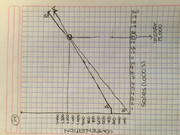
Image

114)
Salesperson A's compensation for any week is $360 plus..

Adding a visual graph to answer any questions out there--hope this helps!
Join the discussion