In the figure above, an equilateral triangle is inscribed in

This topic has expert replies
Moderator
Posts: 7187
Joined: Thu Sep 07, 2017 4:43 pm
Followed by:23 members

Timer

00:00

Your Answer

A

B

C

D

E

Global Stats

Image

In the figure above, an equilateral triangle is inscribed in a circle. If the arc bounded by adjacent corners of the triangle is between 4Ï€4Ï€ and 6Ï€6Ï€ long, which of the following could be the diameter of the circle?

(A) 6.5
(B) 9
(C) 11.9
(D) 15
(E) 23.5

OA D

Source: Manhattan Prep
Source: — Problem Solving |

Legendary Member
Posts: 2214
Joined: Fri Mar 02, 2018 2:22 pm
Followed by:5 members

by deloitte247 » Sun Oct 28, 2018 8:36 am
Since the measurement of central angle is twice the measure of the angle at the circumference then each of the 3 archs corresponds to 120degree central angle
Therefore,each are bounded by the adjacent corner of the triangle corresponds to 1/3 of the circumference of the circle
Given that :
$$4\pi\ <\frac{2\pi r}{3}<6<\pi$$ (multiplying through by $$\frac{3}{\pi}$$ )
$$4\cdot3<2r<6\cdot3$$
$$\sin ce\ diameter\ d=2r$$
$$12<2r<6\cdot3<$$ , hence diameter will be the range of 13,14, 15, 16, 17 the only corresponding
$$option\ is\ D$$ $$=15$$

User avatar
GMAT Instructor
Posts: 1449
Joined: Sat Oct 09, 2010 2:16 pm
Thanked: 59 times
Followed by:33 members

by fskilnik@GMATH » Sun Oct 28, 2018 12:15 pm
BTGmoderatorDC wrote:Image
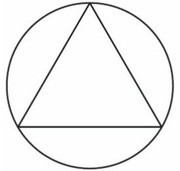
In the figure above, an equilateral triangle is inscribed in a circle. If the arc bounded by adjacent corners of the triangle is between 4Ï€ and 6Ï€ long, which of the following could be the diameter of the circle?

(A) 6.5
(B) 9
(C) 11.9
(D) 15
(E) 23.5
Source: Manhattan Prep
$$?\,\,\,:\,\,\,D = 2r\,\,\,\,\underline {{\rm{could}}} \,\,\,{\rm{be}}$$
$$4\pi \,\,\, < \,\,\,{\rm{arc}}\,\,{\rm{length}}\,\,{\rm{ = }}\,\,{1 \over 3}\left( {2\pi r} \right)\,\,\, < \,\,\,6\pi \,\,\,\,\,\,\mathop \Rightarrow \limits^{:\,\,\pi \,\,\,{\rm{and}}\,\,\, \cdot \,\,3} \,\,\,\,\,4 \cdot 3\,\,\, < \,\,2r\,\, < \,\,6 \cdot 3\,\,\,\,\,\,\,\,\,\, \Rightarrow \,\,\,\,\,\,\,\,\left( D \right)$$

This solution follows the notations and rationale taught in the GMATH method.

Regards,
Fabio.
Fabio Skilnik :: GMATH method creator ( Math for the GMAT)
English-speakers :: https://www.gmath.net
Portuguese-speakers :: https://www.gmath.com.br


















