BREAKING: Target Test Prep releases Brand New 2026 On Demand GMAT prep course

Redeem

In the diagram above, angle \(C=90^o\) and \(AC=BC\). Point

Expert replies
by BTGmoderatorLU » Mon Jun 17, 2019 5:33 pm

Timer

00:00

Answers

A

B

C

D

E

Stats

Difficulty

Source: Magoosh

Image

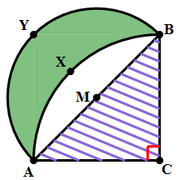
In the diagram above, angle \(C=90^o\) and \(AC=BC\). Point \(M\) is the midpoint of \(AB\). Arc \(AXB\) has its center at \(C\) and passes through \(A\) and \(B\). Arc \(AYB\) has its center at \(M\) and passes through \(A\) and \(B\). The shaded region between the two arcs is called a "lune". What is the ratio of the area of the lune to the area of triangle \(ABC\)?

A. \(1\)

B. \(\frac{\pi}{2}\)

C. \(\frac{\pi}{3}\)

D. \(\frac{3\pi}{8}\)

E. \(\frac{4\pi}{9}\)

The OA is A
Join the discussion
Source: — Problem Solving |

by Jay@ManhattanReview » Tue Jun 18, 2019 12:02 am
BTGmoderatorLU wrote:Source: Magoosh

Image

In the diagram above, angle \(C=90^o\) and \(AC=BC\). Point \(M\) is the midpoint of \(AB\). Arc \(AXB\) has its center at \(C\) and passes through \(A\) and \(B\). Arc \(AYB\) has its center at \(M\) and passes through \(A\) and \(B\). The shaded region between the two arcs is called a "lune". What is the ratio of the area of the lune to the area of triangle \(ABC\)?

A. \(1\)

B. \(\frac{\pi}{2}\)

C. \(\frac{\pi}{3}\)

D. \(\frac{3\pi}{8}\)

E. \(\frac{4\pi}{9}\)

The OA is A

Since the question wants the answer in ratio, we can assume a convenient value for the sides of the triangle.

Say for the rightangled triangle, AC = BC = 1; thus, hypotenuse, AB = √2

Given that Arc \(AXB\) has its center at \(C\) and passes through \(A\) and \(B\), area of segment AXBCA = (Ï€r^2)/4; where r = AC = 1

Thus, the area of segment AXBCA = (πr^2)/4 = π*1^2/4 = π/4

Also, given that Arc \(AYB\) has its center at \(M\) and passes through \(A\) and \(B\), area of segment AYBA = (πR^2)/2; where R = AM = AB/2 = √2/2 = 1/√2

Thus, the area of segment AYBA = (πR^2)/2 = (π*(1/√2)^2)/2 = π/4

Thus, the area of "lune" = area of segment AYBA - area of segment AXBMA = area of segment AYBA - [area of segment AXBCA - ∆ABC] =

= area of segment AYBA - [area of segment AXBCA - ∆ABC]

= π/4 - [π/4 - 1/2*1*1] = 1/2

Thus, ratio of the area of the lune to the area of triangle \(ABC\) = (1/2) / (1/2) = 1

The correct answer: A

Hope this helps!

-Jay
_________________
Manhattan Review GMAT Prep

Locations: GRE Manhattan | ACT Prep Courses San Francisco | IELTS Prep Courses Boston | Seattle IELTS Tutoring | and many more...

Schedule your free consultation with an experienced GMAT Prep Advisor! Click here.
Join the discussion