Resp007 wrote:HI Mitch,
The question never asked when they meet. It says when they are to the nearest 10 feet.
Or
If you can please tell me what does the following line mean?
how many feet farther, to the nearest 10 ft, will Henry walk than James?
Thanks
Resp007
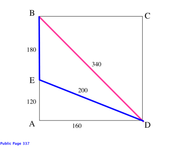
From the question prompt:
James and Henry are at the northwest corner (point B).
James walks in a straight line directly to the southeast corner (point D).
Henry walks...to the southeast corner (point D).
Since James and Henry both walk to the southeast corner, they meet at point D.
How many feet farther...will Henry walk than James?
To walk FARTHER is to walk a GREATER DISTANCE.
Since James walks in a straight line and Henry takes a less direct route, Henry walks farther than James.
The question stem asks for the DIFFERENCE between the distance traveled by Henry and that traveled by James.
To the nearest 10 feet implies that the difference between the two distances can be approximated.
I suspect that this phrase is included because the dimensions of the field (300 feet and 160 feet) can lead to some messy arithmetic.
But approximation is not necessary here.
As shown in my solution above, the exact difference between Henry's distance and James's distance can be calculated quickly if we recognize that ∆ABD is a multiple of an 8-15-17 triangle and that ∆ADE is a multiple of a 3-4-5 triangle.
Private tutor exclusively for the GMAT and GRE, with over 20 years of experience.
Followed here and elsewhere by over 1900 test-takers.
I have worked with students based in the US, Australia, Taiwan, China, Tajikistan, Kuwait, Saudi Arabia -- a long list of countries.
My students have been admitted to HBS, CBS, Tuck, Yale, Stern, Fuqua -- a long list of top programs.
As a tutor, I don't simply teach you how I would approach problems.
I unlock the best way for YOU to solve problems.
For more information, please email me (Mitch Hunt) at
[email protected].
Student Review #1
Student Review #2
Student Review #3
























