Quick note at the top: it seems like your degree symbols are coming out as an exponent raising each answer to the third power.
There are a couple of important things we need to know to solve this question.
First, we need to know that a regular pentagon is one where all interior angles are the same measurement and where all sides are the same length.
Second, we need to know that the interior angle sum for any polygon is (n-2)*180, where n is the number of sides.
Since we have a hexagon (5 sides), the interior angle sum must be (5-2)*180 = 3*180 = 540 degrees. Then since all of the angles have the same measurement, and there are 5 angles, each angle must measure 540/5 = 108 degrees.
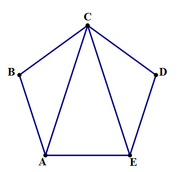
So we know that angles B and D are 108 degrees. Let's think about the triangles ABC and CDE individually. Since we also know that AB and BC as well as CD and DE are the same length, this means that the angles next to those sides (BAC and BCA as well as DCE and DEC) must also be equal. A triangle has an interior angle sum of 180 degrees. So if B and D are 108 degrees, and all of the other angles in the triangles are the same size, we can write the equation 180 = B + BAC + BCA = D + DCE + DEC = 108 + 2x, where x is the measure of BAC, BCA, DCE, and DEC. So 180 = 108 + 2x. Finally, solving for x gives us 36 degrees.
Looking at angle BCD, we see that it is composed of angles BCA, ACE, and DCE. We already know that angle BCD must equal 108 degrees, and we just found out that angles BCA and DCE are 36 degrees. So we can write the equation 108 = BCD = BCA + ACE + DCE = ACE + 2(36). So 108 = ACE + 2(36). Solving for ACE gives 36, which is answer choice C.
For problems like these, I'd recommend drawing the diagram from the problem on your own paper and labeling everything you figure out. So here, you would fill in all of the angle measurements you know. This makes building the equations used in this problem much easier.