On a DS geometry question with no diagram given, try to draw different versions of a diagram based on the information given.
Question: What is the area of the quadrilateral with vertices A, B, C, and D?
We have no information about the quadrilateral to begin with. We will at least need some information about the type of quadrilateral (square, trapezoid, etc) and the dimensions (side lengths, diagonals, etc).
(1) The perimeter of ABCD is equal to 16.
Try to draw different shapes that would have the same perimeters but different areas:
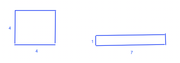
The area of the square = 16, but the area of the rectangle = 7. Insufficient.
(2) Quadrilateral ABCD is a rhombus.
This contains no information about dimensions. It could be a giant rhombus or a teeny tiny one. Insufficient.
(1) & (2) together:
Try to draw 2 different rhombuses (rhombi? Jury is out <i class="em em-wink"></i> ) that both have a perimeter of 16 (i.e. side lengths of 4):
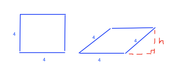
The square has an area of 16, but the rhombus would have an area less than 16. In any parallelogram, the area = base*height. The height in this case would be something less than 4, as 4 is the hypotenuse of the right triangle.
Since we can envision several different rhombuses with different areas, the statements are insufficient to answer the question.
The answer is
E.
Ceilidh Erickson
EdM in Mind, Brain, and Education
Harvard Graduate School of Education























