Anaira Mitch wrote: ↑Thu Mar 22, 2018 6:10 pm
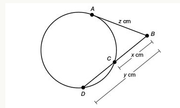
In the figure above, AB, which has length z cm, is tangent to the circle at point A, and BD, which has length y cm, intersects the circle at point C. If BC = x cm and z=sqrt(xy), what is the value of x ?
(1) CD = x cm
(2) z= 5sqrt(2)
Solution:
We need to determine the value of x.
Statement One Alone:
Notice that the combined length of CD and BC equals the length of BD; thus, y = 2x. Substituting this into the equation z = √(xy), we obtain:
z = √(xy) = √(x * 2x) = √(2x^2) = x√2
Since we know nothing about the value of z, we cannot determine the value of x. Statement one alone is not sufficient.
Statement Two Alone:
We know z = 5√2 and we know z = √(xy); however, without a relation between x and y, this is not enough information to calculate the value of x. For instance, if y = 25 and x = 2; then √(xy) = √(50) = 5√2. In this case, the value of x is 2. On the other hand, if y = 10 and x = 5, then again √(xy) = 5√2, but in this case, the value of x is 5.
Statement two alone is not sufficient.
Statements One and Two Together:
Using the analysis of statement one, we know z = x√2 and using statement two, we know z = 5√2. Setting the two expressions of z equal to each other, we obtain x√2 = 5√2, which implies x = 2. Statements one and two together are sufficient.
Answer: C
Scott Woodbury-Stewart
Founder and CEO
[email protected]
 See why Target Test Prep is rated 5 out of 5 stars on BEAT the GMAT. Read our reviews
























