AbeNeedsAnswers wrote: ↑Tue Aug 22, 2017 7:37 pm
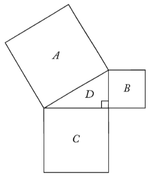
In the figure above, if the area of triangular region D is 4, what is the length of a side of square region A ?
(1) The area of square region B is 9.
(2) The area of square region C is 64/9.
D
Solution:
We need to determine the length of a side of square region A, given that the area of triangular region D is 4. Notice that region D is a right triangle. Therefore, if we know the lengths of the two legs of the triangle D, then by the Pythagorean theorem, we can determine the length of its hypotenuse, which is also a side of square A.
Statement One Alone:
Since the area of square region B is 9, its side length is 3. Since the area of triangle region D is 4, we can let x be the length of the side that is common to both regions D and C and create the equation (notice that the side is the base of the triangle):
½ * x * 3 = 4
3/2 * x = 4
x = 4 * ⅔ = 8/3
Recall that we determined that if we know the lengths of the two legs of triangle D, we can determine the length of a side of square A. Since now we have the lengths of both legs of triangle D, the length of a side of square A can be determined. Statement one alone is sufficient.
Statement Two Alone:
Since the area of square region C is 64/9, its side length is 8/3. Since the area of triangle region D is 4, we can let y be the length of the side that is common to both regions D and B and create the equation (notice that the side is the height of the triangle):
½ * 8/3 * y = 4
4/3 * y = 4
y = 4 * ¾ = 3
Recall that we determined that if we know the lengths of the two legs of triangle D, we can determine the length of a side of square A. Since we now know the lengths of both legs of triangle D, the length of a side of square A can be determined. Statement two alone is sufficient.
Answer: D
Scott Woodbury-Stewart
Founder and CEO
[email protected]
 See why Target Test Prep is rated 5 out of 5 stars on BEAT the GMAT. Read our reviews


























