boomgoesthegmat wrote: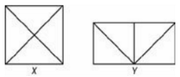
Figures X and Y above show how eight identical triangular pieces of cardboard were used to form a square and a rectangle, respectively. What is the ratio of the perimeter of X to the perimeter of Y?
A) 2 : 3
B) √2 : 2
C) 2√2 : 3
D) 1 : 1
E) √2 : 1
OA:
C
Let's start by gathering more information about these eight identical triangles.
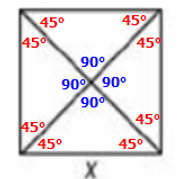
First notice that we have 4 equal angles meeting at a single point.
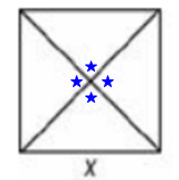
So, each angle must be 90°
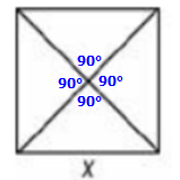
Now examine the red triangle below.
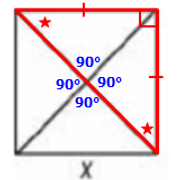
The red triangle is an isosceles triangle since all 4 sides of a square are equal.
The two equal angles must add to 90°
So, each angle must be 45°
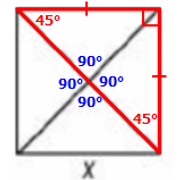
Using similar logic, we can conclude that all of the eight triangles are 45-45-90 special right triangles.
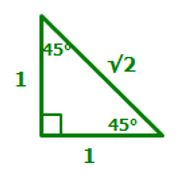
Now let's examine what happens if we examine one particular 45-45-90 special right triangle, which has sides of length 1, 1 and √2
Use those lengths for all eight identical triangles in the 2 diagrams we get the following:
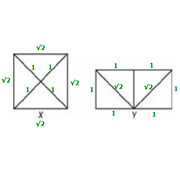
At this point, we can calculate the perimeters.
Perimeter of X = √2 + √2 + √2 + √2 = 4√2
Perimeter of Y = 1 + 1 + 1 + 1 + 1 + 1 = 6
So, perimeter of X : perimeter of Y = 4√2 : 6
Divide both sides by 2 to get the equivalent ratio 2√2 : 3
Answer: C
Brent Hanneson - Creator of GMATPrepNow.com

























