BREAKING: Target Test Prep releases Brand New 2026 On Demand GMAT prep course

Redeem

Which of the following gives all possible values of \(x\)

Expert replies
by BTGmoderatorLU » Wed Aug 14, 2019 3:32 pm

Timer

00:00

Answers

A

B

C

D

E

Stats

Difficulty

Source: Official Guide

Image

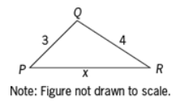
Which of the following gives all possible values of \(x\) in the figure above?

A. \(1 < x < 4\)
B. \(1 < x < 7\)
C. \(3 < x < 5\)
D. \(4 < x < 7\)
E. \(5 < x < 12\)

The OA is B
Join the discussion
Source: — Problem Solving |

by Brent@GMATPrepNow » Wed Aug 14, 2019 4:02 pm
BTGmoderatorLU wrote:Source: Official Guide

Image

Which of the following gives all possible values of \(x\) in the figure above?

A. \(1 < x < 4\)
B. \(1 < x < 7\)
C. \(3 < x < 5\)
D. \(4 < x < 7\)
E. \(5 < x < 12\)

The OA is B
IMPORTANT RULE: If two sides of a triangle have lengths A and B, then . . .
DIFFERENCE between A and B < length of third side < SUM of A and B

Applying the above rule, we get: 4 - 3 < x < 4 + 3
Simplify: 1 < x < 7

Answer: B

Cheers,
Brent
Brent Hanneson - Creator of GMATPrepNow.com
Image
Join the discussion

by Scott@TargetTestPrep » Sun Aug 18, 2019 6:28 pm
BTGmoderatorLU wrote:Source: Official Guide

Image

Which of the following gives all possible values of \(x\) in the figure above?

A. \(1 < x < 4\)
B. \(1 < x < 7\)
C. \(3 < x < 5\)
D. \(4 < x < 7\)
E. \(5 < x < 12\)

The OA is B
In any triangle, the length of the third side must be more than the difference of the other sides and less than the sum of those two sides. Therefore, we have:

4 - 3 < x < 4 + 3

1 < x < 7

Answer: B

Scott Woodbury-Stewart
Founder and CEO
[email protected]

Image

See why Target Test Prep is rated 5 out of 5 stars on BEAT the GMAT. Read our reviews

ImageImage
Join the discussion