A fair coin has 2 distinct flat sides-one of which bears the image of a face and the other of which does not-and when the coin is tossed, the probability that the coin will land faceup is \(\frac{1}{2}\). For certain values of M, N, p, and q, when M fair coins are tossed simultaneously, the probability is p that all M coins land faceup, and when N fair coins are tossed simultaneously, the probability is q that all N coins land face up. Furthermore, \(M < N\) and \(\frac{1}{p} + \frac{1}{q} = 72\).
In the table, select a value for \(M\) and a value for \(N\) that are jointly consistent with the given information. Make only two selections, one in each column.
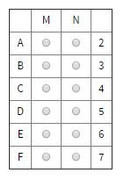
The OA is [spoiler]M=3 N=6[/spoiler]
Source: Official Guide
In the table, select a value for \(M\) and a value for \(N\) that are jointly consistent with the given information. Make only two selections, one in each column.
The OA is [spoiler]M=3 N=6[/spoiler]
Source: Official Guide