Hi All,
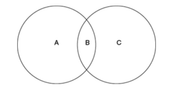
We're told that in the figure above, A, B, and C are the areas, respectively, of the three non-overlapping regions formed by the intersection of two circles of EQUAL area. We're asked for the value of B + C. While this question might look like it might be step-heavy, there are some Geometry patterns that we can use to our advantage. To start, it's worth noting that the question is asking for the area of one of the circles (and since we're told that the circles have the SAME area, if we can determine the area of EITHER circle, then we can answer the question). Second, since B is an 'equal part' of both circles, we know that A=C.
(1) A + 2B + C = 24
With the equation in Fact 1, we can break the calculation into 2 equal 'pieces': (A+B) and (B+C). We know that those pieces are the SAME, so they each have HALF the total area - an area of 12 (and that is the answer to the question).
Fact 1 is SUFFICIENT
(2) A + C = 18 and B = 3
Fact 2 gives us the exact values we need to find the area of either circle. Since A=C, with the equation A+C = 18, we know that A=C=9. When combined with B=3, we know the area of each circle (re: 9+3 = 12)
Fact 2 is SUFFICIENT
Final Answer: D
GMAT assassins aren't born, they're made,
Rich