BREAKING: Target Test Prep releases Brand New 2026 On Demand GMAT prep course

Redeem

What is the area of the quadrilateral with vertices A, B, C,

Expert replies
by BTGmoderatorDC » Sun Nov 11, 2018 3:58 pm

Timer

00:00

Answers

A

B

C

D

E

Stats

Difficulty

What is the area of the quadrilateral with vertices A, B, C, and D?

(1) The perimeter of ABCD is equal to 16.

(2) Quadrilateral ABCD is a rhombus.

OA E

Source: Manhattan Prep
Join the discussion
Source: — Data Sufficiency |

by fskilnik@GMATH » Tue Nov 13, 2018 12:33 pm
BTGmoderatorDC wrote:What is the area of the quadrilateral with vertices A, B, C, and D?

(1) The perimeter of ABCD is equal to 16.

(2) Quadrilateral ABCD is a rhombus.

Source: Manhattan Prep
\[? = {S_{ABCD}}\]

Let´s BIFURCATE statements (1) and (2) together, so that we prove the correct answer is (E).

\[\left( {1 + 2} \right)\,\,4x = 16\,\,\, \Rightarrow \,\,\,x = 4\,\,\,\left( {{\text{each}}\,\,{\text{side}}\,\,{\text{length}}} \right)\]

Image

Note that a square with edge 4 has an area of 16, while the other rhombus (shown in the right) has an area different from 16.

(A careful reader realizes it is possible to have an area as small as we wish, I mean, positive but as near as 0 as desired!)


This solution follows the notations and rationale taught in the GMATH method.

Regards,
Fabio.
Fabio Skilnik :: GMATH method creator ( Math for the GMAT)
English-speakers :: https://www.gmath.net
Portuguese-speakers :: https://www.gmath.com.br
Join the discussion

by ceilidh.erickson » Tue Nov 13, 2018 12:40 pm
On a DS geometry question with no diagram given, try to draw different versions of a diagram based on the information given.

Question: What is the area of the quadrilateral with vertices A, B, C, and D?

We have no information about the quadrilateral to begin with. We will at least need some information about the type of quadrilateral (square, trapezoid, etc) and the dimensions (side lengths, diagonals, etc).

(1) The perimeter of ABCD is equal to 16.

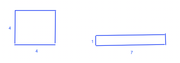
Try to draw different shapes that would have the same perimeters but different areas:
Image

The area of the square = 16, but the area of the rectangle = 7. Insufficient.


(2) Quadrilateral ABCD is a rhombus.

This contains no information about dimensions. It could be a giant rhombus or a teeny tiny one. Insufficient.


(1) & (2) together:

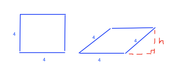
Try to draw 2 different rhombuses (rhombi? Jury is out <i class="em em-wink"></i> ) that both have a perimeter of 16 (i.e. side lengths of 4):
Image

The square has an area of 16, but the rhombus would have an area less than 16. In any parallelogram, the area = base*height. The height in this case would be something less than 4, as 4 is the hypotenuse of the right triangle.

Since we can envision several different rhombuses with different areas, the statements are insufficient to answer the question.

The answer is E.
Ceilidh Erickson
EdM in Mind, Brain, and Education
Harvard Graduate School of Education
Join the discussion

by ceilidh.erickson » Tue Nov 13, 2018 12:44 pm
Fabio beat me to the post while I was still drawing diagrams <i class="em em-wink"></i>
But mine will take you through both statements individually, in case anyone couldn't rule them out as insufficient.
Ceilidh Erickson
EdM in Mind, Brain, and Education
Harvard Graduate School of Education

Join the discussion

















