BREAKING: Target Test Prep releases Brand New 2026 On Demand GMAT prep course

Redeem

Which is closest to zero?

Expert replies
Source: — Data Sufficiency |

by Patrick_GMATFix » Thu Feb 27, 2014 2:54 pm
In short, the 1st statement guarantees that 0 is half-way between q and s, so r must be the closest to 0. I go through the question in detail in the full solution below (taken from the GMATFix App).

Image

-Patrick
Last edited by Patrick_GMATFix on Thu Feb 27, 2014 2:56 pm, edited 1 time in total.
  • Ask me about tutoring.
Join the discussion

by Brent@GMATPrepNow » Thu Feb 27, 2014 2:55 pm
Image
Of the four numbers represented on the number line, is r closest to zero?

(1) q = -s
(2) -t < q
Target question: Is r closest to zero?
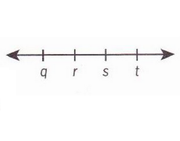
Statement 1: q = -s
This tells us that q and s are on opposite sides of zero (i.e., one is positive and one is negative) AND it tells us that q and s are the same distance from zero.
So, we get something like this: q.....0.....s
Since r is between points q and s, r must be the closest point to zero
Since we can answer the target question with certainty, statement 1 is SUFFICIENT

Statement 2: -t < q
There are several sets of values that satisfy this condition. Here are two:
Case a: q = -1, r = 0, s = 1 and t = 2, in which case r IS the closest to zero
Case b: q = 0, r = 1, s = 2 and t = 3, in which case r is NOT the closest to zero
Since we cannot answer the target question with certainty, statement 2 is NOT SUFFICIENT

Answer = A

Cheers,
Brent
Brent Hanneson - Creator of GMATPrepNow.com
Image
Join the discussion

by Mike@Magoosh » Thu Feb 27, 2014 3:02 pm
BlueDragon2010 wrote:Image

Of the four number represented on the number line above, is r closest to zero?

(1) q = -s

(2) -t < q
Dear BlueDragon2010,
I'm happy to help with this. :-)

Remember, of course, diagrams are not necessarily drawn to scale in GMAT DS. SEe
https://magoosh.com/gmat/2012/gmat-trick ... -possible/

Statement #1:
If q = -s, then zero must be the midpoint of the segment from q to s. Well, even if the diagram is not to scale, any point between q & s will be close to the midpoint than either q or s would be. Thus, r must be closest to zero. This answer gives a very clear answer, so this statement is sufficient.

Statement #2:
-t < q. Well, let's just consider the points evenly spaced. It could be that q = -1, r = 0, s = 1, and t = 2 --- then, this inequality would be true. It could also be that q = 1, r = 2, s = 3, and t = 4, and this inequality would still be true. Even more possibilities emerge when we consider that the points might not be evenly spaced, because the diagram is not necessarily drawn to scale. With the two choices we made so far, r was closest to zero in one, and q was closest to zero in another. With uneven choices, we could also make s the one closest to zero. This statement allows for different configurations that result in different answer to the prompt question. This statement, along and by itself, is not sufficient.

Answer = [spoiler](B)[/spoiler]

Does all this make sense?
Mike :-)
Magoosh GMAT Instructor
https://gmat.magoosh.com/
Join the discussion

by Brent@GMATPrepNow » Fri Feb 28, 2014 6:40 am
Mike@Magoosh wrote: Remember, of course, diagrams are not necessarily drawn to scale in GMAT DS. SEe
https://magoosh.com/gmat/2012/gmat-trick ... -possible/
Be sure to note Mike's advice. When it comes to Geometry questions on the GMAT, there are assumptions we CAN make and there are others we CANNOT make.

If you're interested, we have a free video that covers all of this: https://www.gmatprepnow.com/module/gmat-geometry?id=863

Cheers,
Brent
Brent Hanneson - Creator of GMATPrepNow.com
Image
Join the discussion

by divyasood11 » Sun Dec 14, 2014 9:52 am
Hi Mike
can you suggest a strategy which makes it easy and quick to come up with such sets of numbers quickly during the test

Thank You
Join the discussion

by [email protected] » Sun Dec 14, 2014 12:30 pm
Hi divyasood11,

When you choose to TEST VALUES on DS questions, you have to focus on the "thoroughness" of your examples. DS questions often come with "restrictions" that you have to account for and the specific question that is asked often focuses on a specific idea that should help you to further measure the thoroughness of your work.

As a general rule, you want to use small, simple values (-3, -2, -1, 0, 1, 2, 3, etc.)...unless something in the prompt clues you in to do otherwise.

Here, we're first restricted by the picture. Since we're dealing with a number line, we know that Q < R < S < T. 4 variables is A LOT, so you really should focus on simple values. Now, consider the possibilities:

all positive
all negative
0 could be in there
a mix of positives, 0 and negatives is possible

Next, we have the question: "Is R closest to zero?"

If Q, S or T is actually 0, then the answer is NO.
If Q, S or T is closer to 0 than R, then the answer is NO.
If R actually is closer than both Q and S, then we'll know that it's closer than T, so the answer would be YES.

Once you get down to the two Facts, additional restrictions show up. As a general rule, I choose values first for the variables that I know the most about.

In Fact 1, Q = -S

This means that Q and S are OPPOSITES (and neither can be 0). From the number line, we know that Q < S, so Q MUST be negative and S MUST be positive. After making these deductions, what values would YOU choose for Q and S? Now, since R is somewhere between Q and S, what COULD you choose for R?

With enough practice, all of these steps will become natural (and faster). This type of work requires lots of note-taking though, so you should NEVER do this work in your head.

GMAT assassins aren't born, they're made,
Rich
Contact Rich at [email protected]
Image
Join the discussion

by Scott@TargetTestPrep » Fri Nov 02, 2018 4:06 pm
BlueDragon2010 wrote:Image

Of the four number represented on the number line above, is r closest to zero?

(1) q = -s

(2) -t < q
We need to determine whether r is closest to zero.

Statement One Alone:

q = -s

Since q = -s, q and s are opposites. For example, q = 2 and s = -2, or, q = -3 and s = 3. However, since q is to the left of s, q must be negative and s must be positive. Because q and s are opposites, zero must be exactly halfway between q and s. Since variable r is also between q and s we know that r is closer to zero than any other variable on our number line.

Statement one is sufficient to answer the question. We can eliminate answer choices B, C, and D.

Statement Two Alone:

-t < q

Since statement two is comparing the possible values of -t and q with an inequality, we do not have any significant information that will allow us to determine an exact location of zero on the number line. For example, if q = 1, r = 2, s = 3 and t = 4, then q is closer to 0 than r is. If q = -1, r = 0, s = 1, and t = 2, then r is closest to 0 since r itself is 0. Since we can have two contradictory scenarios, statement two does not provide enough information to answer the question.

Answer: A

Scott Woodbury-Stewart
Founder and CEO
[email protected]

Image

See why Target Test Prep is rated 5 out of 5 stars on BEAT the GMAT. Read our reviews

ImageImage
Join the discussion




















