BREAKING: Target Test Prep releases Brand New 2026 On Demand GMAT prep course

Redeem

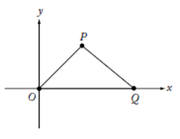
In the rectangular coordinate system above, if OP < PQ,

Expert replies
by BTGmoderatorLU » Wed Jul 18, 2018 3:09 pm

Timer

00:00

Answers

A

B

C

D

E

Stats

Difficulty

Image

In the rectangular coordinate system above, if OP < PQ, is the area of region OPQ greater than 48?

(1) The coordinates of point P are (6, 8).
(2) The coordinates of point Q are (13, 0).

The OA is A.

Please, can someone assist me with this DS question? Thanks in advance!
Join the discussion
Source: — Data Sufficiency |

by Jay@ManhattanReview » Wed Jul 18, 2018 8:54 pm
BTGmoderatorLU wrote:Image

In the rectangular coordinate system above, if OP < PQ, is the area of region OPQ greater than 48?

(1) The coordinates of point P are (6, 8).
(2) The coordinates of point Q are (13, 0).

The OA is A.

Please, can someone assist me with this DS question? Thanks in advance!
In the diagram, it is given that OP < PQ.

We have to determine whether the area of region OPQ greater than 48.

Area of the triangle OPQ = 1/2*Base*Height = 1/2*OQ*Height

To get the height of the triangle OPQ, we must drop a perpendicular from point P on the Base OQ. Say the perpendicular meets OQ at point R; thus, Height = PR

Area of the triangle OPQ = 1/2*OQ*PR

Let's take each statement one by one.

(1) The coordinates of point P are (6, 8).

=> OR = 6 and PR = 8

However, with this information, we can't get the value of 1/2*OQ*PR as we do not have any information about OQ.

We can split OQ as OR + RQ, or OQ = OR + RQ => OQ = 6 + RQ

We are given that OP < PQ; we can make use of this information.

Comparing triangle ORO and triangle PRQ under the light of OP < PQ, we can deduce that OR < RQ. Or, 6 < RQ

Thus, Area of the triangle OPQ = 1/2*OQ*PR = 1/2*OQ*(OR + RQ) = 1/2*6*(6 + RQ) = 1/2*6*(6 + 6+) = 48+

=> Area of the triangle OPQ > 48. Sufficient.

(2) The coordinates of point Q are (13, 0).

=> Base = 13, but we cannot get the height. Insufficient.

The correct answer: C

Hope this helps!

-Jay
_________________
Manhattan Review GMAT Prep

Locations: Manhattan Review Warangal | Hyderabad | GRE Prep Himayatnagar | Dilsukhnagar GRE Coaching | and many more...

Schedule your free consultation with an experienced GMAT Prep Advisor! Click here.
Join the discussion

by ceilidh.erickson » Thu Jul 19, 2018 6:23 am
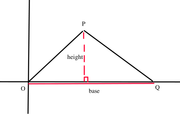
To get the area of this triangle, let's define the base and the height:
Image

The base of the triangle goes from the origin to point Q on the x axis. Thus, the length of that base will be the x-coordinate of point Q.

The height of the triangle will be the height of P. It doesn't really matter where P falls horizontally along the x-axis. The only thing that matters is vertical distance: the height = the y-coordinate of P.

Since area = (1/2)b*h, we're wondering if (1/2)(the x-coord of Q)(the y-coord of P) > 48. Or we can multiply both sides by 2:
Rephrased question: (the x-coord of Q)(the y-coord of P) > 96 ?

Let's look at the statements:

(1) The coordinates of point P are (6, 8).

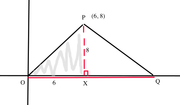
At first, it doesn't look like this will tell us about the entire triangle, since it doesn't give us information about Q. However, it does tell us the area of part of the triangle:
Image
We can create a right triangle with side lengths of 6 and 8, so an area of (1/2)(6)(8) = 24.

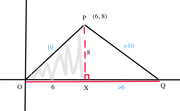
What about the other side of the triangle? We're given that OP < PQ. Since we know that the side lengths of our smaller triangle are 6 and 8, we can conclude that OP = 10. Thus, PQ must be greater than 10:
Image
If that hypotenuse is greater than 10, and one side is 8, the other side must be greater than 6.

Thus, the area of the other triangle must be greater than 24, and the overall triangle must have an area greater than 48.

Sufficient.

(2) The coordinates of point Q are (13, 0).

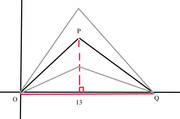
This tells us the length of the base. However, we could imagine a variety of different y-coordinates for P:
Image
These would all give different areas.

Since we can't make any inferences about the height from (2), this is insufficient.

The answer is A.
Ceilidh Erickson
EdM in Mind, Brain, and Education
Harvard Graduate School of Education

Join the discussion

by [email protected] » Thu Jul 19, 2018 1:59 pm
Hi All,

We're told that in the rectangular coordinate system above, OP < PQ. We're asked if the area of region OPQ is greater than 48. This is a YES/NO question and it's a great 'concept' question, meaning that if you recognize the concepts involved, then you don't actually have to do much math to answer the question.

To start, since OP < PQ, that means that whatever the X-coordinate of Point P is, it is CLOSER to the Origin (re: X=0, Y=0), then it is to Point Q. In addition, since we're dealing with a triangle, the area can be determined by A = (1/2)(Base)(Height).

1) The coordinates of point P are (6, 8).

With the information in Fact 1, we know the HEIGHT of the triangle (its height is 8). We also know that since the X-coordinate of Point P is closer to the Origin than it is to Point Q, Point Q has an X-coordinate that is GREATER than 12. Thus, the area of the triangle is.... A = (1/2)(8)(something greater than 12) = greater than (4)(12) = greater than 48. Thus, the answer to the question is ALWAYS YES.
Fact 1 is SUFFICIENT

2) The coordinates of point Q are (13, 0).

The information in Fact 2 gives us the length of the BASE of the triangle (its base is 13), but we know NOTHING about the height.
IF....
The height = 1, then the area = (1/2)(1)(13) = 6.5 and the answer to the question is NO.
The height = 10, then the area = (1/2)(10)(13) = 65 and the answer to the question is YES.
Fact 2 is INSUFFICIENT

Final Answer: A

GMAT assassins aren't born, they're made,
Rich
Contact Rich at [email protected]
Image
Join the discussion