BREAKING: Target Test Prep releases Brand New 2026 On Demand GMAT prep course

Redeem

Target Test Prep · GMAT

Choose how you want to prepare

Learn live with an expert or move at your own pace. Every option includes the complete TTP study system.

★★★★★5.0559 reviews
GMATBootcamp Starts Sep 28
Chris Peckover, Target Test Prep GMAT expert
LIVE ONLINE BOOTCAMP

Live Online Bootcamp Class with Top GMAT Expert Chris Peckover

15 live classes from Sep 28, 2026

Schedule
Mon to Fri · 7:00 to 10:00 PM ET
Included
Live classes + 6 months of TTP OnDemand
  • Boost your GMAT score in less than one month in a live online class
  • 6 months access to TTP OnDemand video courses included
View bootcamp & enroll
Limited cohort · enrollment openTarget Test Prep
EALiveTeach 5 seats left
Logan Thompson
EXECUTIVE ASSESSMENT

Sep 6 to Dec 6, 2026

with Logan Thompson

Schedule
Sun · 9:30 AM to 12:30 PM ET
Included
40 hours of live online classes plus six months of access to the complete TTP EA OnDemand course.
  • 165+ EA Score Guarantee
  • 4,100+ Quant, Verbal, and Integrated Reasoning practice questions
  • 400+ hours of in-depth video lessons
  • 3,000+ step-by-step video solutions
View EA class & enroll
Limited cohort · enrollment openTarget Test Prep
GMATOnDemand Start anytime
SELF-PACED MASTERCLASS

Target Test Prep GMAT OnDemand

Complete access from day one. Study on your schedule.

715+ score guarantee
$0to start then $127/mo
  • Personalized study plan and analytics
  • Thousands of lessons and practice questions

Compare the format, schedule, and included access before enrolling. Prices and seat counts shown reflect the supplied offer details.

Geometry

Problem Solving — algebra and arithmetic (GMAT Focus Edition)
Expert replies
Source: — Quantitative Reasoning |

by Ian Stewart » Mon Jul 24, 2017 8:45 pm
If (a, 4) and (a, b+1) are on the same line, and that line isn't vertical, they must be the same point, because they have the same x-coordinate. So b+1 = 4, and b = 3. We know (4, b) is on the line, so if b = 3, the point (4, 3) is on the line. That means the point must work in the line's equation:

y = kx + 1

Plugging in x = 4 and y = 3, we have

3 = 4k + 1
k = 1/2

There's a way to do this without using as much algebra, but you need to understand slopes well. If a line has this equation:

y = kx + 1

then its y-intercept is 1, so the point (0, 1) is on the line. When we find that (4, 3) is also on the line, we know that when we move across 4 units, from x=0 to x=4, the line rises by 2 units, from y=1 to y=3. Since slope = rise/run, slope = 2/4 = 1/2. Since k is the slope of the line, that's the answer. Or once you have the two points, you could just use the slope formula.

All that said, the answer choices are bizarre. A GMAT question would never include "1 and 1/2" as an answer choice to a slope question; they would always write "5/2". What is the source?
For online GMAT math tutoring, or to buy my higher-level Quant books and problem sets, contact me at ianstewartgmat at gmail.com

ianstewartgmat.com
Join the discussion

by Brent@GMATPrepNow » Tue Jul 25, 2017 6:10 am
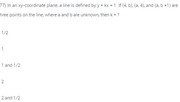
In an xy-coordinate plane, a line is defined by y = kx + 1. If (4, b), (a, 4), and (a, b +1) are three points on the line, where a and b are unknown, then k = ?

a) 1/2
b) 1
c) 1 1/2
d) 2
e) 2 1/2
There's a HUGE CLUE in the fact that (a, 4) and (a, b+1) are both on the same line. Notice that the x-coordinates are the same. If the x-coordinates are the same, then there are two possible scenarios:
scenario #1: The points (a, 4) and (a, b+1) are DIFFERENT points, in which case the line is vertical (with undefined slope)
scenario #2: The points (a, 4) and (a, b+1) define the SAME point

IMPORTANT: If a line is defined by y = kx + 1, then k represents the slope. So, the question is really asking us to find the slope of the line.

In scenario #1, the slope would be undefined. Since none of the answer choices are undefined, we can rule out scenario #1, which means (a, 4) and (a, b+1) define the SAME point. So, we can be certain that b+1 = 4, which means b = 3

Now that we know that b = 3, we can use the fact that the point (4,b) is on the line.
This means that the point (4,3) is on the line y = kx + 1.
When we plug x=4 and y=3 into the equation, we get 3 = (k)(4) + 1
Solve to get k = 1/2

Answer: A

Cheers,
Brent
Brent Hanneson - Creator of GMATPrepNow.com
Image
Join the discussion

by Matt@VeritasPrep » Sun Aug 06, 2017 10:41 pm
Equations are the best way here, but we could always go for another set of them from the ones given above.

k = the slope of the line, and since k = 0 isn't an option in the answers, know the line ISN'T horizontal. We also know that k is defined, so the line can't be perfectly vertical either.

Since the line isn't horizontal or vertical, we can't have two points with the same x or y-coordinate on the line. (a, 4) and (a, b + 1) have the same x-coordinate, and we just saw that they can't be different points, so they must be the SAME POINT, and 4 = b + 1.

That gives b = 3, from which we know that (4, 3) and (a, 4) are two points on the line.

Plugging (4, 3) into the equation y = kx + 1 gives us 3 = 4k + 1, or k = 1/2.
Join the discussion