BREAKING: Target Test Prep releases Brand New 2026 On Demand GMAT prep course

Redeem

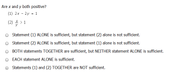
Are X and Y both positive

Expert replies
Source: — Data Sufficiency |

by 800_or_bust » Sun Jun 26, 2016 11:01 am
shubh425 wrote:Please explain.


Image
(1) Not sufficient. x = 1, y = 1/2 OR x = 1/2, y = 0, etc...

(2) Not sufficient. This implies x and y have the same sign, and x has a larger absolute value than y. But they could both be positive, or both be negative.

Combined (1) and (2) are sufficient. If x and y were both negative and x has a larger absolute value than y, then 2x - 2y has to evaluate to be negative. You would be adding a positive term to a negative term with a larger absolute value, and the result would always be negative. Thus, x and y must both be positive. The answer is C.
800 or bust!
Join the discussion

by Brent@GMATPrepNow » Sun Jun 26, 2016 11:17 am
Are x and y both positive?
1) 2x - 2y =1
2) x/y >1
Target question: Are x and y both positive?

Statement 1: 2x - 2y = 1
There are several pairs of numbers that satisfy this condition. Here are two:
Case a: x = 1 and y = 0.5, in which case x and y are both positive
Case b: x = -0.5 and y = -1, in which case x and y are not both positive
Since we cannot answer the target question with certainty, statement 1 is NOT SUFFICIENT

Statement 2: x/y > 1
This tells us that x/y is positive. This means that either x and y are both positive or x and y are both negative. Here are two possible cases:
Case a: x = 4 and y = 2, in which case x and y are both positive
Case b: x = -4 and y = -2, in which case x and y are not both positive
Since we cannot answer the target question with certainty, statement 2 is NOT SUFFICIENT

Statements 1 and 2
Statement 1 tells us that 2x - 2y = 1.
Divide both sides by 2 to get: x - y = 1/2
Solve for x to get x = y + 1/2

Now take the statement 2 inequality (x/y > 1) and replace x with y + 1/2 to get:
(y + 1/2)/y > 1
Rewrite as: y/y + (1/2)/y > 1
Simplify: 1 + 1/(2y) > 1
Subtract 1 from both sides: 1/(2y) > 0
If 1/(2y) is positive, then y must be positive.

Statement 2 tells us that either x and y are both positive or x and y are both negative.
Now that we know that y is positive, it must be the case that x and y are both positive
Since we can now answer the target question with certainty, the combined statements are SUFFICIENT

Answer = C

Cheers,
Brent
Brent Hanneson - Creator of GMATPrepNow.com
Image
Join the discussion

by evs.teja » Tue Jun 28, 2016 4:38 am
Brent@GMATPrepNow wrote:
Are x y both positive?
1) 2x - 2y =1
2) x/y >1
Target question: Are x y both positive?

Statement 2: x/y > 1
This tells us that x/y is positive. This means that either x y are both positive or x y are both negative. Here are two possible cases:
Case a: x = 4 y = 2, in which case x y are both positive
Case b: x = -4 y = -2, in which case x y are not both positive
Since we cannot answer the target question with certainty, statement 2 is NOT SUFFICIENT

Brent
Dear Brent,
Could you please clear this doubt of mine.
IS x/y>1 != x>y
I solved this problem in this process
Since x/y>1 it should also follow x>y
if x=3 , y=2
3/2>1 and 3>2.
whereas if x=-4 y=-2
x/y >1
but x>y is false
so B is sufficient , both x y should be positive.

Where am I thinking wrong?
Regards
Teja
Join the discussion

by Brent@GMATPrepNow » Tue Jun 28, 2016 8:18 am
evs.teja wrote:
Dear Brent,
Could you please clear this doubt of mine.
IS x/y>1 != x>y

I solved this problem in this process
Since x/y>1 it should also follow x>y
if x=3 , y=2
3/2>1 and 3>2.
whereas if x=-4 y=-2
x/y >1
but x>y is false
so B is sufficient , both x y should be positive.

Where am I thinking wrong?
Regards
Teja
The part above (in green) is incorrect.
You have taken x/y > 1 and multiplied both sides by y to get x > y
We can only do this if we are CERTAIN that y is positive.

For example, we know that 3/2 > 1
If we multiply both sides by 2, we get 3 > 2. Great!

However, what about this case: (-3)/(-2) > 1
If we multiply both sides by -2, we get -3 > -2. Oops!

Since can cannot be certain that y is positive in the inequality x/y > 1, we cannot multiply both sides by y to get x > y

For more on this, see the following video: https://www.gmatprepnow.com/module/gmat ... /video/979
Brent Hanneson - Creator of GMATPrepNow.com
Image
Join the discussion

by Danny@GMATAcademy » Tue Jun 28, 2016 8:38 am
I think most points are lost on this question when test takers try to multiply both sides of the inequality in statement 2 by y to get x > y.

The reason we cannot do this is that we don't know whether y is positive or negative. Recall that for inequalities, if you multiply or divide by a negative, you have to flip the direction of the inequality sign ( 3 > 2 ----> -3 < -2). But if we don't know the sign of the thing your multiplying both sides by, we don't know if the inequality sign stays the same or flips around.

Often, I find it very helpful to keep track of both options. For example, here:


x/y > 1

case 1: if y pos: x > y

case 2: if y neg: x < y


For this question, doing this might help make the subsequent deductions a little easier. Statement 1 can be written as x = y + 1/2. In other words, x is 1/2 greater than y. And if x is greater, we can't be in case 2 above. We must be in case 1. y must be positive. And if y is positive, and x is greater than y, x muust be positive too.
Join the discussion

by 800_or_bust » Wed Jun 29, 2016 6:10 am
evs.teja wrote:
Brent@GMATPrepNow wrote:
Are x y both positive?
1) 2x - 2y =1
2) x/y >1
Target question: Are x y both positive?

Statement 2: x/y > 1
This tells us that x/y is positive. This means that either x y are both positive or x y are both negative. Here are two possible cases:
Case a: x = 4 y = 2, in which case x y are both positive
Case b: x = -4 y = -2, in which case x y are not both positive
Since we cannot answer the target question with certainty, statement 2 is NOT SUFFICIENT

Brent
Dear Brent,
Could you please clear this doubt of mine.
IS x/y>1 != x>y
I solved this problem in this process
Since x/y>1 it should also follow x>y
if x=3 , y=2
3/2>1 and 3>2.
whereas if x=-4 y=-2
x/y >1
but x>y is false
so B is sufficient , both x y should be positive.

Where am I thinking wrong?
Regards
Teja
Remember when you multiply and divide across an equality, the direction of the sign changes if the value being multiplied or divided is negative. Thus, we cannot say that if x/y > 1 that x > y unless we know for certain that y is positive.
800 or bust!
Join the discussion

by Matt@VeritasPrep » Fri Jul 08, 2016 2:44 pm
We could also say

x - y = 1/2

and

x/y > 1
x/y - 1 > 0
(x - y)/y > 0

Combining the two, we have

(1/2)/y > 0

So y must be positive. Since y > 0, we know x = 1/2 + (something greater than 0), so x is also positive.

This keeps us away from the sign-flipping hazard, and is easier for some students to see (and believe!)
Join the discussion