binit wrote:Hi experts,
I solved this CR in in some way and my answer is B.
From Q stem we have: 1. If Do not study well ---> Then Fail.
2. If Study more than 10 hrs ---> Then Chance of Passing. (10 hrs is Necessary but not Sufficient).
Now take answer choices:
(A) Anyone who studies for more than ten hours has more of a chance of passing the test than those who study for fewer than ten hours. This is not true for all since 10 hrs DO NOT suffice to pass, a guy can fail after studying 20 hrs too, and he stands no way more chances of passing to one who fails studying, say, 5 hrs.
(B) No number of hours will suffice to ensure a passing grade. True. We do not have a SUFFICIENT condition of passing (in terms of hrs)
(C) If someone does not want to fail the test, he or she had better study for at least ten hours. Maybe true and may not be. This asks about how to minimize the chance to FAIL which can be done by study well. No. of hrs is related to passing, as per the professor.
(D) Those who don't study for at least 10 hours will surely fail the course. Not 100% true. If they STUDY WELL they will not FAIL.
(E) The professor's course is one of the harder courses of that year.Irrelevant.
Pls tell me where am I wrong??
~Binit.
Hey Binit, the mistake that you are making with answer choice B is that you are going beyond the argument. Answer choice B may be true or it may be false, the argument doesn't address it. We know that if you study for fewer than 10 hours you will fail the test. That is all that we know in terms of hours. Therefore, maybe if you study over 10 you maybe will pass, or maybe if you study over 10 you definitely will pass, or maybe if you study between 10 and 20 hours you maybe will pass but if you study over 20 hours you definitely will pass...we don't know, these are all possibilities. All of this is outside of the scope of the argument, and therefore we cannot make any inferences regarding it. You are assuming that because no mention is made of a number of studying hours that will make passing a guarantee, that it doesn't exist. We can't infer that.
Answer choice C nicely rewords the premise, making it a great correct answer to an inference question. The premise states that you must study for at least 10 hours to have a chance at passing, meaning that if you study for fewer than 10 hours you are doomed to fail. Answer choice C says the same thing because if you do not want to be doomed to fail the test, then you had better study for at least 10 hours.
Does all of that make sense? Be careful with scope on inference questions, because tricky wrong answers (like B here) are often wrong because they go beyond the scope of the argument and are thus not necessarily true.
Side note, answer choice D is wrong because of the scope shift between test and course, not because of the reasoning that you gave. If they study for fewer hours they are guaranteed to fail the test, and if answer choice D had used the word "test" it would be a correct inference.



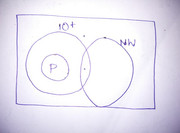

 Somehow this suits me and the peculiar thing is that I really don't remember a time when I learned how to apply Venn diagrams in CR problems. Maybe I have an affinity for diagrams (and repulsion for texts: RC
  )
) 


















