BREAKING: Target Test Prep releases Brand New 2026 On Demand GMAT prep course

Redeem

Target Test Prep · GMAT

Choose how you want to prepare

Learn live with an expert or move at your own pace. Every option includes the complete TTP study system.

★★★★★5.0559 reviews
GMATLiveTeach Starts Oct 17
Chris Peckover, Target Test Prep GMAT expert
LIVE ONLINE CLASSES

Get Ready for GMAT Test Day Faster with Live Online Classes

with Chris Peckover, 100th-Percentile GMAT Scorer

Oct 17 · Chris Peckover
Sat · 11:00 AM to 2:00 PM ET
Oct 20 · Chris Peckover
Tue, Thu · 8:00 to 10:00 PM ET
Oct 25 · Josh Braslow
Sun · 1:00 to 4:00 PM ET
Included
40 hours of live online classes + 6 months of TTP OnDemand
  • Attend the first class for free
  • Every class is recorded, so you never fall behind
View classes & enroll
Limited seats availableTarget Test Prep
EALiveTeachOnDemand 5 seats left Start anytime
EXECUTIVE ASSESSMENT

Target Test Prep EA OnDemand

Self-paced EA prep. Study on your schedule.

Logan Thompson
EXECUTIVE ASSESSMENT

Sep 6 to Dec 6, 2026

with Logan Thompson

165+ EA score guarantee
$05-day trial no automatic billing
Schedule
Sun · 9:30 AM to 12:30 PM ET
Included
40 hours of live online classes plus six months of access to the complete TTP EA OnDemand course.
  • 165+ EA Score Guarantee
  • 4,100+ Quant, Verbal, and Integrated Reasoning practice questions
  • 400+ hours of in-depth video lessons
  • 3,000+ step-by-step video solutions
View EA class & enroll Start free 5-day trial
Limited cohort · enrollment openTrial includes full course accessTarget Test Prep
GMATOnDemand Start anytime
SELF-PACED MASTERCLASS

Target Test Prep GMAT OnDemand

Complete access from day one. Study on your schedule.

715+ score guarantee
$0to start then $127/mo
  • Personalized study plan and analytics
  • Thousands of lessons and practice questions

Compare the format, schedule, and included access before enrolling. Prices and seat counts shown reflect the supplied offer details.

Breakup of total expenses

Expert replies
by conquistador » Mon Apr 13, 2015 5:24 am
Breakup of total expenses of the five divisions M, N, O, P and Q of company X

Image

Note -: The figure shown is not necessarily to scale.
The figure above shows a circle graph. The circle has a centre of C and gives the division wise breakup of the total expenses of company X in terms of percentages. How many of the five divisions have an expense which is more than the average (arithmetic mean) of the expenses of the five divisions?
(1) a > 19 > b > c > d > e
(2) a > 21 > b > c > d > e
Join the discussion
Source: — Data Sufficiency |

by [email protected] » Mon Apr 13, 2015 9:21 am
Hi Mechmeera,

You'll likely find that a mixture of conceptual thinking and TESTing VALUES will help you to deal with this situation.

We're told that the pie chart represents TOTAL expenses, so we know that we're dealing with 100% of the expenses. Since there are 5 divisions, we also know that the AVERAGE expenses per division = 100/5 = 20% of the total.

The question asks how many divisions have expenses that are MORE than the average (meaning MORE than 20%).

Fact 1: A > 19 > B > C > D > E

For the average to be 20%, AT LEAST one of the five divisions must be greater than 20%. Here, there's only one possible division that fits that rule (Division A); all of the other divisions are LESS than 19%. Thus, the answer to the question is 1 division.
Fact 1 is SUFFICIENT

Fact 2: A > 21 > B > C > D > E

Here, we could have a few different possibilities:

IF....A,B,C,D,E are...
26, 20, 19, 18, 17 then the answer to the question is 1 division

IF...A,B,C,D,E are....
26, 20.5, 19, 18, 16.5 then the answer to the question is 2 divisions
Fact 2 is INSUFFICIENT

Final Answer: A

GMAT assassins aren't born, they're made,
Rich
Contact Rich at [email protected]
Image
Join the discussion

by mallika hunsur » Tue Apr 14, 2015 4:18 am
[email protected] wrote:Hi Mechmeera,

You'll likely find that a mixture of conceptual thinking and TESTing VALUES will help you to deal with this situation.

We're told that the pie chart represents TOTAL expenses, so we know that we're dealing with 100% of the expenses. Since there are 5 divisions, we also know that the AVERAGE expenses per division = 100/5 = 20% of the total.

The question asks how many divisions have expenses that are MORE than the average (meaning MORE than 20%).

Fact 1: A > 19 > B > C > D > E

For the average to be 20%, AT LEAST one of the five divisions must be greater than 20%. Here, there's only one possible division that fits that rule (Division A); all of the other divisions are LESS than 19%. Thus, the answer to the question is 1 division.
Fact 1 is SUFFICIENT

Fact 2: A > 21 > B > C > D > E

Here, we could have a few different possibilities:

IF....A,B,C,D,E are...
26, 20, 19, 18, 17 then the answer to the question is 1 division

IF...A,B,C,D,E are....
26, 20.5, 19, 18, 16.5 then the answer to the question is 2 divisions
Fact 2 is INSUFFICIENT

Final Answer: A

GMAT assassins aren't born, they're made,
Rich
:)
Join the discussion

by Brent@GMATPrepNow » Wed Apr 15, 2015 10:50 am
Mechmeera wrote:Breakup of total expenses of the five divisions M, N, O, P and Q of company X
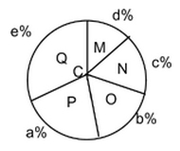
Image

Note -: The figure shown is not necessarily to scale.
The figure above shows a circle graph. The circle has a centre of C and gives the division wise breakup of the total expenses of company X in terms of percentages. How many of the five divisions have an expense which is more than the average (arithmetic mean) of the expenses of the five divisions?
(1) a > 19 > b > c > d > e
(2) a > 21 > b > c > d > e
Target question: How many of the five divisions have an expense which is more than the average (arithmetic mean) of the expenses of the five divisions?

This is a great candidate for REPHRASING the target question.

IMPORTANT: If we add the percentages (a%, b%, c%, d%, and e%), we get 100%
So, the average percent share = 100%/5 = 20%

So, we can REPHRASE the target question....
REPHRASED target question: How many of the five divisions have MORE than 20% of the TOTAL expenses

Aside: We have a free video with tips on rephrasing the target question: https://www.gmatprepnow.com/module/gmat- ... cy?id=1100

Now onto the statements....

Statement 1: a > 19 > b > c > d > e
We know that b, c, d and e have less than 19% of the total expenses, which means they each have less than 20% of the TOTAL expenses.
If b, c, d and e each = less than 19%, then b+c+d+e is less than (4)(19%)
(4)(19%) = 74%, which means division a must comprise more than 26% percent of the TOTAL expenses.
So, exactly 1 division has MORE than 20% of the TOTAL expenses
Since we can answer the REPHRASED target question with certainty, statement 1 is SUFFICIENT

Statement 2: a > 21 > b > c > d > e
There are several values of a, b, c, d and e that satisfy statement 2. Here are two:
Case a: a = 23, b = 20.5, c = 19.5, d = 19 and e = 18. In this case, 2 divisions have MORE than 20% of the TOTAL expenses
Case b: a = 62, b = 11, c = 10, d = 9 and e = 8. In this case, 1 division has MORE than 20% of the TOTAL expenses
Since we cannot answer the REPHRASED target question with certainty, statement 2 is NOT SUFFICIENT

Answer = A

Cheers,
Brent
Brent Hanneson - Creator of GMATPrepNow.com
Image
Join the discussion



















