BREAKING: Target Test Prep releases Brand New 2026 On Demand GMAT prep course

Redeem

Target Test Prep · GMAT

Choose how you want to prepare

Learn live with an expert or move at your own pace. Every option includes the complete TTP study system.

★★★★★5.0559 reviews
GMATLiveTeach Starts Oct 17
Chris Peckover, Target Test Prep GMAT expert
LIVE ONLINE CLASSES

Get Ready for GMAT Test Day Faster with Live Online Classes

with Chris Peckover, 100th-Percentile GMAT Scorer

Oct 17 · Chris Peckover
Sat · 11:00 AM to 2:00 PM ET
Oct 20 · Chris Peckover
Tue, Thu · 8:00 to 10:00 PM ET
Oct 25 · Josh Braslow
Sun · 1:00 to 4:00 PM ET
Included
40 hours of live online classes + 6 months of TTP OnDemand
  • Attend the first class for free
  • Every class is recorded, so you never fall behind
View classes & enroll
Limited seats availableTarget Test Prep

EALiveTeachOnDemand 5 seats left Start anytime
EXECUTIVE ASSESSMENT

Target Test Prep EA OnDemand

Self-paced EA prep. Study on your schedule.

Logan Thompson
EXECUTIVE ASSESSMENT

Sep 6 to Dec 6, 2026

with Logan Thompson

165+ EA score guarantee
$05-day trial no automatic billing
Schedule
Sun · 9:30 AM to 12:30 PM ET
Included
40 hours of live online classes plus six months of access to the complete TTP EA OnDemand course.
  • 165+ EA Score Guarantee
  • 4,100+ Quant, Verbal, and Integrated Reasoning practice questions
  • 400+ hours of in-depth video lessons
  • 3,000+ step-by-step video solutions
View EA class & enroll Start free 5-day trial
Limited cohort · enrollment openTrial includes full course accessTarget Test Prep
GMATOnDemand Start anytime
SELF-PACED MASTERCLASS

Target Test Prep GMAT OnDemand

Complete access from day one. Study on your schedule.

715+ score guarantee
$0to start then $127/mo
  • Personalized study plan and analytics
  • Thousands of lessons and practice questions

Compare the format, schedule, and included access before enrolling. Prices and seat counts shown reflect the supplied offer details.

probability.

Expert replies
by Md.Nazrul Islam » Thu Apr 12, 2012 5:34 am
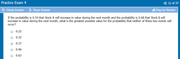
If the probability is 0.54 that stock A will increase in value during the next month and the probability is 0.68 that B stock will increase in value during the next month .what is the greatest possible value that neither of these two events will occur ?
Join the discussion
Source: — Problem Solving |

by Shalabh's Quants » Thu Apr 12, 2012 6:29 am
Md.Nazrul Islam wrote:If the probability is 0.54 that stock A will increase in value during the next month and the probability is 0.68 that B stock will increase in value during the next month .what is the greatest possible value that neither of these two events will occur ?
Given is P(A) = 0.54; P(Not A) = 1-0.54 = 0.46;

Similarly, P(B) = 0.68; P(Not B) = 1-0.68 = 0.32;

Prob. of none of the events to occur = P(Not A)*P(Not B) =0.46*0.32 = 0.1472.
Shalabh Jain,
e-GMAT Instructor
Join the discussion

by Stuart@KaplanGMAT » Thu Apr 12, 2012 9:40 am
Md.Nazrul Islam wrote:If the probability is 0.54 that stock A will increase in value during the next month and the probability is 0.68 that B stock will increase in value during the next month .what is the greatest possible value that neither of these two events will occur ?
Hello!

This is a non-GMAT question for 2 reasons. First, there are no answer choices. Second, GMAT probability always deals with INDEPENDENT events - here, not only does the question not specify that the events are independent, but it also implies that they could be dependant. After all, if they were independent the question would never read "the greatest possible value that neither" would occur, it would just ask for the probability that neither would occur.

Normally I wouldn't address a non-GMAT question (other than to warn students off of it), but this does help us understand the difference between independent and dependant, so what the heck. However, I want to reiterate, THERE IS NO CHANCE OF THIS QUESTION (or a similar one) EVER APPEARING ON THE GMAT. This smacks of a "home made" question - I'm always wary of new posters who don't include the source of their questions.

We know that stock B has a 68% chance to increase; since it has a higher % chance than A, there's no way that stock B could be dependant on stock A.

However, stock A's performance could be 100% dependant on stock B's. Since we want to MAXIMIZE the probability that neither event will occur, we want to make stock A completely dependant on B. If that's the case, then there's a 32% chance that neither event will occur. Accordingly, 32% is the correct answer to the question.
Image

Stuart Kovinsky | Kaplan GMAT Faculty | Toronto

Kaplan Exclusive: The Official Test Day Experience | Ready to Take a Free Practice Test? | Kaplan/Beat the GMAT Member Discount
BTG100 for $100 off a full course
Join the discussion

by mgm » Sat Sep 28, 2013 1:50 pm
This problem showed up on GMATPrep 3 .
Join the discussion

by ppravin88 » Mon Nov 11, 2013 11:30 am
Stuart Kovinsky wrote:
Md.Nazrul Islam wrote:If the probability is 0.54 that stock A will increase in value during the next month and the probability is 0.68 that B stock will increase in value during the next month .what is the greatest possible value that neither of these two events will occur ?
Hello!

This is a non-GMAT question for 2 reasons. First, there are no answer choices. Second, GMAT probability always deals with INDEPENDENT events - here, not only does the question not specify that the events are independent, but it also implies that they could be dependant. After all, if they were independent the question would never read "the greatest possible value that neither" would occur, it would just ask for the probability that neither would occur.

Normally I wouldn't address a non-GMAT question (other than to warn students off of it), but this does help us understand the difference between independent and dependant, so what the heck. However, I want to reiterate, THERE IS NO CHANCE OF THIS QUESTION (or a similar one) EVER APPEARING ON THE GMAT. This smacks of a "home made" question - I'm always wary of new posters who don't include the source of their questions.

We know that stock B has a 68% chance to increase; since it has a higher % chance than A, there's no way that stock B could be dependant on stock A.

However, stock A's performance could be 100% dependant on stock B's. Since we want to MAXIMIZE the probability that neither event will occur, we want to make stock A completely dependant on B. If that's the case, then there's a 32% chance that neither event will occur. Accordingly, 32% is the correct answer to the question.

Image

This question appeared in the latest GMAT Prep Exam Pack 1!
Join the discussion

by GMATGuruNY » Mon Nov 11, 2013 5:51 pm
To MAXIMIZE the probability of a BAD outcome (that neither A nor B happens), we must MINIMIZE the probability of a GOOD outcome (that either A or B happens).
The probability of a good outcome will be minimized if one of the probabilities DEPENDS on the other.
Let's rephrase the problem so that one of the probabilities is more clearly dependent on the other.
Let A = John wins the lottery.
Let B = John buys a lottery ticket.
Here, the probability of A is clearly dependent on the probability of B: John can win the lottery only if he first buys a ticket.
Question rephrased:
If the probability that John wins the lottery is 0.54, and the probability that John buys a lottery ticket is 0.68, what is the greatest possible value for the probability that neither of these two events will occur?

A. 0.22
B. 0.32
C. 0.37
D. 0.46
E. 0.63
If John DOESN'T buy a lottery ticket, then NEITHER event will occur.
P(John doesn't buy a lottery ticket) = 1 - 0.68 = 0.32.

The correct answer is B.

Aside: If anyone knows of a lottery with these odds, please purchase a ticket on my behalf.
Private tutor exclusively for the GMAT and GRE, with over 20 years of experience.
Followed here and elsewhere by over 1900 test-takers.
I have worked with students based in the US, Australia, Taiwan, China, Tajikistan, Kuwait, Saudi Arabia -- a long list of countries.
My students have been admitted to HBS, CBS, Tuck, Yale, Stern, Fuqua -- a long list of top programs.

As a tutor, I don't simply teach you how I would approach problems.
I unlock the best way for YOU to solve problems.

For more information, please email me (Mitch Hunt) at [email protected].
Student Review #1
Student Review #2
Student Review #3
Join the discussion

by Milovan » Thu Nov 14, 2013 12:41 am
If we need to maximize the probability that neither occur, isn't better to say that A = John buys a lottery ticket. We would then have 1 - 0,54 = 0,46
Is this wrong?
Milovan Arnaut
Join the discussion

by [email protected] » Thu Nov 14, 2013 1:16 pm
Hi Milovan,

The wording of the question asks for the probability that NEITHER even will occur (so, we're looking for the odds that John DOESN'T BUY a tick AND he DOESN'T WIN).

Your example involves John BUYING a ticket. This doesn't match what the prompt asks for, so the result is not correct.

GMAT assassins aren't born, they're made,
Rich
Contact Rich at [email protected]
Image
Join the discussion

by Milovan » Fri Nov 15, 2013 7:41 am
[email protected] wrote:Hi Milovan,

The wording of the question asks for the probability that NEITHER even will occur (so, we're looking for the odds that John DOESN'T BUY a tick AND he DOESN'T WIN).

Your example involves John BUYING a ticket. This doesn't match what the prompt asks for, so the result is not correct.

GMAT assassins aren't born, they're made,
Rich
Hi Rich,

Maybe you misunderstand me. I have set that A = buying a lottery. Therefore P(a)=0,54 and further P(notA) = 1 - 0,54 = 0,46

So, my assumption is that if stock A does not increase stock B will not increase (reversed compared with the GMATGuruNY's assumption). In this scenario probability that neither will occur is higher, which is the task of the question.

Could you please explain me what am I missing?

Thanks
Milovan Arnaut
Join the discussion

by GMATGuruNY » Fri Nov 15, 2013 9:15 am
Milovan wrote:If we need to maximize the probability that neither occur, isn't better to say that A = John buys a lottery ticket. We would then have 1 - 0,54 = 0,46
Is this wrong?
If P(buys a ticket) = 0.54 and P(wins) = 0.68, then the probability of buying a ticket is LESS than the probability of winning.
This makes no sense.
Clearly, it is easier to buy a ticket than to win.
Thus, probability of buying a ticket must be GREATER than probability of winning.
Private tutor exclusively for the GMAT and GRE, with over 20 years of experience.
Followed here and elsewhere by over 1900 test-takers.
I have worked with students based in the US, Australia, Taiwan, China, Tajikistan, Kuwait, Saudi Arabia -- a long list of countries.
My students have been admitted to HBS, CBS, Tuck, Yale, Stern, Fuqua -- a long list of top programs.

As a tutor, I don't simply teach you how I would approach problems.
I unlock the best way for YOU to solve problems.

For more information, please email me (Mitch Hunt) at [email protected].
Student Review #1
Student Review #2
Student Review #3
Join the discussion

by Mathsbuddy » Sat Nov 16, 2013 2:45 pm
Stuart Kovinsky wrote:
Md.Nazrul Islam wrote:If the probability is 0.54 that stock A will increase in value during the next month and the probability is 0.68 that B stock will increase in value during the next month .what is the greatest possible value that neither of these two events will occur ?
Hello!

This is a non-GMAT question for 2 reasons. First, there are no answer choices. Second, GMAT probability always deals with INDEPENDENT events - here, not only does the question not specify that the events are independent, but it also implies that they could be dependant. After all, if they were independent the question would never read "the greatest possible value that neither" would occur, it would just ask for the probability that neither would occur.

Normally I wouldn't address a non-GMAT question (other than to warn students off of it), but this does help us understand the difference between independent and dependant, so what the heck. However, I want to reiterate, THERE IS NO CHANCE OF THIS QUESTION (or a similar one) EVER APPEARING ON THE GMAT. This smacks of a "home made" question - I'm always wary of new posters who don't include the source of their questions.

We know that stock B has a 68% chance to increase; since it has a higher % chance than A, there's no way that stock B could be dependant on stock A.

However, stock A's performance could be 100% dependant on stock B's. Since we want to MAXIMIZE the probability that neither event will occur, we want to make stock A completely dependant on B. If that's the case, then there's a 32% chance that neither event will occur. Accordingly, 32% is the correct answer to the question.
I don't see why differences in probability affect dependence.
Surely the probabilities are given as absolute, so Shalabh Jain's answer could not be exceeded.
Clarity on this matter would be much appreciated.
Thanks.
Join the discussion

by Milovan » Sun Nov 17, 2013 4:14 am
GMATGuruNY wrote:
Milovan wrote:If we need to maximize the probability that neither occur, isn't better to say that A = John buys a lottery ticket. We would then have 1 - 0,54 = 0,46
Is this wrong?
If P(buys a ticket) = 0.54 and P(wins) = 0.68, then the probability of buying a ticket is LESS than the probability of winning.
This makes no sense.
Clearly, it is easier to buy a ticket than to win.
Thus, probability of buying a ticket must be GREATER than probability of winning.
Hi Mitch,

I totally agree on that one with you. However, in the question we had, situation relates to two stocks. In that one we can not differ probabilities like you did in your example with buying a ticket and winning a lottery.

So, my question is why we took 0.68 and not 0.54 to subtract from 1 since in that case we would get higher probability? That means of course that we need to change starting assumption that rise of the stock with probability of 0.68 directly depends from the rise of the stock with probability 0.54.

Thanks
Milovan Arnaut
Join the discussion

by GMATGuruNY » Sun Nov 17, 2013 5:15 am
Milovan wrote: So, my question is why we took 0.68 and not 0.54 to subtract from 1 since in that case we would get higher probability? That means of course that we need to change starting assumption that rise of the stock with probability of 0.68 directly depends from the rise of the stock with probability 0.54.

Thanks
Strategy:
To MINIMIZE the probability that either A or B happens, make one of the probabilities DEPENDENT on the other.
In other words:
One event will be INDEPENDENT: it can happen ON ITS OWN.
The other event will be DEPENDENT: it can happen only if the first event happens.

Since the first event can happen on its own, it's EASIER for the first event to happen.
Thus, it must have the GREATER probability.
Since the second event depends on the first event, it's HARDER for the second event to happen.
Thus, it must have the SMALLER probability.

Applying this reasoning to the problem above:
The first event -- the INDEPENDENT probability -- must be Stock B, with a probability of 0.68.
The second event -- the DEPENDENT probability -- must be Stock A, with a probability of 0.54.
Private tutor exclusively for the GMAT and GRE, with over 20 years of experience.
Followed here and elsewhere by over 1900 test-takers.
I have worked with students based in the US, Australia, Taiwan, China, Tajikistan, Kuwait, Saudi Arabia -- a long list of countries.
My students have been admitted to HBS, CBS, Tuck, Yale, Stern, Fuqua -- a long list of top programs.

As a tutor, I don't simply teach you how I would approach problems.
I unlock the best way for YOU to solve problems.

For more information, please email me (Mitch Hunt) at [email protected].
Student Review #1
Student Review #2
Student Review #3
Join the discussion

by Mathsbuddy » Sun Nov 17, 2013 6:09 am
If we consider all these dependency arguments, then surely (?):

Assuming B is independent, but A dependends on B,
P(B independent) = 0.68
P(A which is dependent on B) = P(B and then A) = P(B independent) * P(A independent) = 0.54

So P(A independent) = 0.54/0.68 = 0.794117647

P(not A ind) = 1 - 0.794117647 = 0.205882353
P(not B ind) = 1 - 0.68 = 0.32

P(C) = P(Not A ind AND Not B ind) = 0.205882353 * 0.32 = 0.065882353

P(D) = P(Not A dep AND Not B ind) = 0.46 * 0.32 = 0.1472

P(C OR D) = 0.065882353 + 0.1472 = 0.213082353

Therefore surely the maximum probability is 0.213082353

???
Join the discussion

by GMATGuruNY » Sun Nov 17, 2013 5:20 pm
Mathsbuddy wrote:If we consider all these dependency arguments, then surely (?):

Assuming B is independent, but A dependends on B,
P(B independent) = 0.68
P(A which is dependent on B) = P(B and then A) = P(B independent) * P(A independent) = 0.54

So P(A independent) = 0.54/0.68 = 0.794117647

P(not A ind) = 1 - 0.794117647 = 0.205882353
P(not B ind) = 1 - 0.68 = 0.32

P(C) = P(Not A ind AND Not B ind) = 0.205882353 * 0.32 = 0.065882353

P(D) = P(Not A dep AND Not B ind) = 0.46 * 0.32 = 0.1472

P(C OR D) = 0.065882353 + 0.1472 = 0.213082353

Therefore surely the maximum probability is 0.213082353

???
You're overcomplicating the problem.
To maximize the probability of a BAD outcome (neither A nor B), we want to make it as hard as possible to get a GOOD outcome.
For this reason, we make A depend on B, so it's harder for A to happen.
(As I noted in my post above, we can't make B depend on A, since a greater probability cannot depend on a smaller probability.)

If A depends on B, then A can't happen unless B happens.
Implication:
If B doesn't happen, then NEITHER A NOR B HAPPENS (since A can't happen without B).

Thus, to account for the maximum probability that neither A nor B happens, we need only determine the probability that B doesn't happen.
Since P(B) = 0.68, P(not B) = 1 - 0.68 = 0.32.
Private tutor exclusively for the GMAT and GRE, with over 20 years of experience.
Followed here and elsewhere by over 1900 test-takers.
I have worked with students based in the US, Australia, Taiwan, China, Tajikistan, Kuwait, Saudi Arabia -- a long list of countries.
My students have been admitted to HBS, CBS, Tuck, Yale, Stern, Fuqua -- a long list of top programs.

As a tutor, I don't simply teach you how I would approach problems.
I unlock the best way for YOU to solve problems.

For more information, please email me (Mitch Hunt) at [email protected].
Student Review #1
Student Review #2
Student Review #3
Join the discussion