BREAKING: Target Test Prep releases Brand New 2026 On Demand GMAT prep course

Redeem

Target Test Prep · GMAT

Choose how you want to prepare

Learn live with an expert or move at your own pace. Every option includes the complete TTP study system.

★★★★★5.0559 reviews
GMATLiveTeach Starts Oct 17
Chris Peckover, Target Test Prep GMAT expert
LIVE ONLINE CLASSES

Get Ready for GMAT Test Day Faster with Live Online Classes

with Chris Peckover, 100th-Percentile GMAT Scorer

Oct 17 · Chris Peckover
Sat · 11:00 AM to 2:00 PM ET
Oct 20 · Chris Peckover
Tue, Thu · 8:00 to 10:00 PM ET
Oct 25 · Josh Braslow
Sun · 1:00 to 4:00 PM ET
Included
40 hours of live online classes + 6 months of TTP OnDemand
  • Attend the first class for free
  • Every class is recorded, so you never fall behind
View classes & enroll
Limited seats availableTarget Test Prep
EALiveTeachOnDemand 5 seats left Start anytime
EXECUTIVE ASSESSMENT

Target Test Prep EA OnDemand

Self-paced EA prep. Study on your schedule.

Logan Thompson
EXECUTIVE ASSESSMENT

Sep 6 to Dec 6, 2026

with Logan Thompson

165+ EA score guarantee
$05-day trial no automatic billing
Schedule
Sun · 9:30 AM to 12:30 PM ET
Included
40 hours of live online classes plus six months of access to the complete TTP EA OnDemand course.
  • 165+ EA Score Guarantee
  • 4,100+ Quant, Verbal, and Integrated Reasoning practice questions
  • 400+ hours of in-depth video lessons
  • 3,000+ step-by-step video solutions
View EA class & enroll Start free 5-day trial
Limited cohort · enrollment openTrial includes full course accessTarget Test Prep
GMATOnDemand Start anytime
SELF-PACED MASTERCLASS

Target Test Prep GMAT OnDemand

Complete access from day one. Study on your schedule.

715+ score guarantee
$0to start then $127/mo
  • Personalized study plan and analytics
  • Thousands of lessons and practice questions

Compare the format, schedule, and included access before enrolling. Prices and seat counts shown reflect the supplied offer details.

Power and roots confusion!!

Expert replies
by Jonna89 » Sun Jan 25, 2015 10:41 am
Hi guys! This is my first post in my journey to beat the GMAT! Could you guys please help me understand the below question?

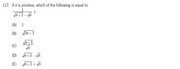
If N is positive, which of the following is equal to 1/(√N+1) - √N?

A. 1
B. (√2N)+1
C. (√N+1)/(√N)
D. (√N)+1-(√N)
E. (√N)+1+(√N)

I can solve most of the equation until I get to {(√N+1)+(√N)}/(N+1)-(√N). The answer is E,but I cannot understand/rationalize how the equation goes from {(√N+1)+(√N)}/(N+1)-(√N) to a result of (√N)+1+(√N). Thank you in advanced!!!

Best,
Jonna! :D
Join the discussion
Source: — Problem Solving |

by Brent@GMATPrepNow » Sun Jan 25, 2015 10:47 am
Jonna89 wrote:Hi guys! This is my first post in my journey to beat the GMAT! Could you guys please help me understand the below question?

If N is positive, which of the following is equal to 1/(√N+1) - √N?

A. 1
B. (√2N)+1
C. (√N+1)/(√N)
D. (√N)+1-(√N)
E. (√N)+1+(√N)

I can solve most of the equation until I get to {(√N+1)+(√N)}/(N+1)-(√N). The answer is E,but I cannot understand/rationalize how the equation goes from {(√N+1)+(√N)}/(N+1)-(√N) to a result of (√N)+1+(√N). Thank you in advanced!!!

Best,
Jonna! :D
I have a question about the notation in your question.
You write 1/(√N+1).
Are we taking the square root of N or N+1?

If we're taking the square root of N+1, it should read: 1/√(N+1).

Cheers,
Brent
Brent Hanneson - Creator of GMATPrepNow.com
Image
Join the discussion

by Jonna89 » Sun Jan 25, 2015 11:06 am
Hi Brent. You are correct, it is √(N+1).The question should read: 1/√(N+1) - (√N). The correct answer is E √(N+1) + √N. Please advise. Thanks!
Join the discussion

by [email protected] » Sun Jan 25, 2015 12:00 pm
Hi Jonna89,

Has the entire prompt (and the answer choices) been properly transcribed? If you can upload a picture of the original question (and answers), then that would probably make all of this easier.

GMAT assassins aren't born, they're made,
Rich
Contact Rich at [email protected]
Image
Join the discussion

by pdvbhat » Sun Jan 25, 2015 1:19 pm
You just need to rationalize, by multiplying the numerator and denominator by (√(N+1) + √N) to get option E, as the denominator will be equal to 1 after rationalization i.e.
(√(N+1)-√N)(√(N+1)+√N)= N+1-N = 1.
Join the discussion

by GMATGuruNY » Sun Jan 25, 2015 1:38 pm
Image

Let n = 2.
Then:
1/(√n+1 - √n) = 1/(√3-√2) ≈ 1/(1.7 - 1.4) = 1/.3 = 10/3. This is our target.

Now plug n=2 into the answers to see which comes closest to our target of 10/3.

Only E works:
√(n+1) + √n = √3+√2 ≈ 1.7 + 1.4 = 3.1.

The correct answer is E.
Private tutor exclusively for the GMAT and GRE, with over 20 years of experience.
Followed here and elsewhere by over 1900 test-takers.
I have worked with students based in the US, Australia, Taiwan, China, Tajikistan, Kuwait, Saudi Arabia -- a long list of countries.
My students have been admitted to HBS, CBS, Tuck, Yale, Stern, Fuqua -- a long list of top programs.

As a tutor, I don't simply teach you how I would approach problems.
I unlock the best way for YOU to solve problems.

For more information, please email me (Mitch Hunt) at [email protected].
Student Review #1
Student Review #2
Student Review #3
Join the discussion

by Matt@VeritasPrep » Sun Jan 25, 2015 3:11 pm
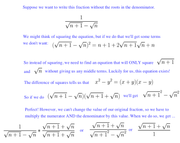
Here's the basic idea, in more legible form: check it out! I tried to make it as thorough as I could.

Image

There's a typo on the screenshot -- (√n+1 - √n)² should give n+1 - 2√n+1√n + n -- but other than that, all should be well.
Join the discussion

by Jonna89 » Sun Jan 25, 2015 6:28 pm
Wow! That actually made so much sense! You guys are awesome!! Thank you! I wish I would have join the site earlier!!! Cheers!
Join the discussion

by Matt@VeritasPrep » Sun Jan 25, 2015 9:00 pm
Jonna89 wrote:Wow! That actually made so much sense! You guys are awesome!! Thank you! I wish I would have join the site earlier!!! Cheers!
Better late than never! Keep up the good work.
Join the discussion

by Brent@GMATPrepNow » Mon Jan 26, 2015 2:37 pm
In mathematics, it's generally considered poor form to write fractions with roots in the denominator (although having roots in the numerator is acceptable). So, to eliminate the roots in the denominator, we must multiple both numerator and denominator by something that accomplishes this.

Here that something is (√(N+1) + √N).

Aside: (√(N+1) + √N) is known as the "conjugate" of (√(N+1) - √N)

Here's another question that tests this concept: https://www.beatthegmat.com/help-roots-q-t271220.html

Cheers,
Brent
Brent Hanneson - Creator of GMATPrepNow.com
Image
Join the discussion