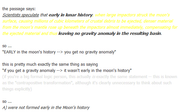
Although this is a short passage, it seems to be very hard for me. Can you please explain?
When a large body strikes a planet or moon, material is ejected, thereby creating a hole in the planet and a local deficit of mass. This deficit shows up as a gravity anomaly: the removal of material that has been ejected to make the hole results in an area in slightly lower gravity than surrounding areas. One would therefore expect that all of the large multi-ring impact basins on the surface of earth's moon would show such negative gravity anomalies, since they are, essentially, large holes in lunar surface. Yet data collected in 1994 by the Clemenstine spacecraft show that many of these Clementine basins have no anomalously low gravity and some even have anomalously high gravity. Scientists speculate that early in lunar history, when large impactors struck the moon's surface, causing millions of cubic kilometers of crustal debris to be ejected, denser material from the moon's mantle rose up beneath the impactors almost immediately, compensating for the ejected material and thus leaving no gravity anomaly in the resulting basin. Later, however, as moon grew cooler and less elastic, rebound from large impactors would have been only partial and incomplete. Thus today such gravitational compensation probably would not occur: the outer layer of moon is too cold and stiff.
According to the passage, the gravitational compensation referred to in the highlighted text is caused by which of the following?
A) A deficit of mass resulting from the creation of hole in lunar surface
B) The presence of material from the impactor in the debris created by its impact
C) The gradual cooling and stiffening of the Moon's outer surface
D) The ejection of massive amounts of debris from the moon's crust
E) The rapid upwelling of material from the lunar mantle
OA: E
The Passage suggests that if the scientists mentioned in the highlighted text are correct in their speculations, the large multi-ring impact basins on the Moon with the most significant negative gravity anomalies probably
A) were not formed early in the Moon's history
B) were not formed by the massive ejection of crustal debris
C) are closely surrounded by other impact basins with anomalously low gravity
D) were created by the impact of multiple large impactors
E) were formed when the moon was relatively elastic
OA: A
The passage is primarily concerned with
A) analyzing data from a 1994 exploration of lunar surface
B) reconciling two opposing theories about the origin of lunar impact basins
C) presenting a possible explanation of a puzzling finding about lunar impact basins
D) discussing how impact basins on the Moon's surface are formed
E) examining the claim that the moon's impact basins show negative gravity anomalies
OA: C
When a large body strikes a planet or moon, material is ejected, thereby creating a hole in the planet and a local deficit of mass. This deficit shows up as a gravity anomaly: the removal of material that has been ejected to make the hole results in an area in slightly lower gravity than surrounding areas. One would therefore expect that all of the large multi-ring impact basins on the surface of earth's moon would show such negative gravity anomalies, since they are, essentially, large holes in lunar surface. Yet data collected in 1994 by the Clemenstine spacecraft show that many of these Clementine basins have no anomalously low gravity and some even have anomalously high gravity. Scientists speculate that early in lunar history, when large impactors struck the moon's surface, causing millions of cubic kilometers of crustal debris to be ejected, denser material from the moon's mantle rose up beneath the impactors almost immediately, compensating for the ejected material and thus leaving no gravity anomaly in the resulting basin. Later, however, as moon grew cooler and less elastic, rebound from large impactors would have been only partial and incomplete. Thus today such gravitational compensation probably would not occur: the outer layer of moon is too cold and stiff.
According to the passage, the gravitational compensation referred to in the highlighted text is caused by which of the following?
A) A deficit of mass resulting from the creation of hole in lunar surface
B) The presence of material from the impactor in the debris created by its impact
C) The gradual cooling and stiffening of the Moon's outer surface
D) The ejection of massive amounts of debris from the moon's crust
E) The rapid upwelling of material from the lunar mantle
OA: E
The Passage suggests that if the scientists mentioned in the highlighted text are correct in their speculations, the large multi-ring impact basins on the Moon with the most significant negative gravity anomalies probably
A) were not formed early in the Moon's history
B) were not formed by the massive ejection of crustal debris
C) are closely surrounded by other impact basins with anomalously low gravity
D) were created by the impact of multiple large impactors
E) were formed when the moon was relatively elastic
OA: A
The passage is primarily concerned with
A) analyzing data from a 1994 exploration of lunar surface
B) reconciling two opposing theories about the origin of lunar impact basins
C) presenting a possible explanation of a puzzling finding about lunar impact basins
D) discussing how impact basins on the Moon's surface are formed
E) examining the claim that the moon's impact basins show negative gravity anomalies
OA: C
Last edited by akhpad on Fri Nov 12, 2010 6:59 am, edited 1 time in total.