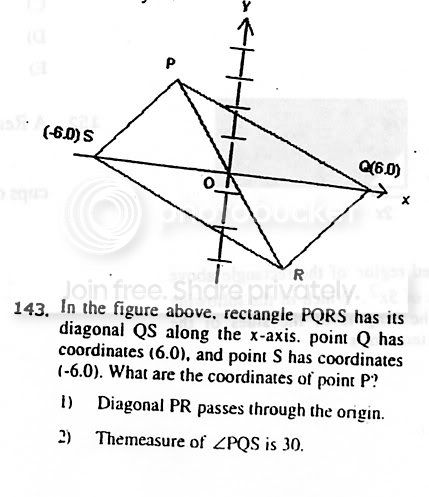
stmt 1 is useless because we already knew that the diagonals pass thru the origin.. the mid-point of (-6,0) (6.0)
stmt 2 gives a lot of details.
PQS = 30
therefore, PSQ = 60
since we know the angles.. on drawing lines at these angles we get the point of intersection, which is P.
I'm not sure if this is the correct explanation though.
Data Sufficiency: Graph-Geometry Probelm
This topic has expert replies
Source: Beat The GMAT — Data Sufficiency |
I've got it.
First before reviewing the statements 1 and 2, we can know that Diagonals of rectangle are equal and bisect each other
=> OP=OS=OQ=OR=QS/2=6
Statement 1: Gives us no new information as it is in the given QS passes through the origin and since O is the midpoint of QS then PR MUST pass thru O and O be its midpoint as diagonals of rectangle bisect each other.
Statement 2: Angle PQS=30 => Triangle SPQ is 30:60:90 triangle
=> SP=SQ/2=6
We already new before that OP=OS=6
Therefore, now we have OP=OS=SP=6
To simplify calculation and since we want to calculate coordinates of P we can say,
OP^2=SP^2 (x=x-coordinate of P, y=y-coordinate of P)
=> y^2 + x^2 = y^2 + (x+6)^2
=> x^2 = x^2+12x+36 (eliminate x^2)
=> 12x+36=0
=> x= -36/12 = -3 and y= 36 - x^2=36-9= 27 => y= 3sqrt(3)
Therefore, P [-3,3sqrt(3) ]
So, the answer is B.
Thanks for not helping guys. But I dont know if I face it in the exam i can eliminate A easily, but you need to know the approach to take to check if B is useful or go for D instead.
Thanks hope it was useful.
First before reviewing the statements 1 and 2, we can know that Diagonals of rectangle are equal and bisect each other
=> OP=OS=OQ=OR=QS/2=6
Statement 1: Gives us no new information as it is in the given QS passes through the origin and since O is the midpoint of QS then PR MUST pass thru O and O be its midpoint as diagonals of rectangle bisect each other.
Statement 2: Angle PQS=30 => Triangle SPQ is 30:60:90 triangle
=> SP=SQ/2=6
We already new before that OP=OS=6
Therefore, now we have OP=OS=SP=6
To simplify calculation and since we want to calculate coordinates of P we can say,
OP^2=SP^2 (x=x-coordinate of P, y=y-coordinate of P)
=> y^2 + x^2 = y^2 + (x+6)^2
=> x^2 = x^2+12x+36 (eliminate x^2)
=> 12x+36=0
=> x= -36/12 = -3 and y= 36 - x^2=36-9= 27 => y= 3sqrt(3)
Therefore, P [-3,3sqrt(3) ]
So, the answer is B.
Thanks for not helping guys. But I dont know if I face it in the exam i can eliminate A easily, but you need to know the approach to take to check if B is useful or go for D instead.
Thanks hope it was useful.




















