This question would be extremely difficult to do without a calculator. This is *not* a good example of a GMAT-like question.
For example, I had to reach for a calculator to double-check the factorization of 361: 19*19. With very rare exceptions, the GMAT only expects you to be able to factor so-called "smooth numbers": numbers that can be broken down into small prime factors of 2, 3, 5, and 7 (very occasionally a single factor of 11 or 13, but rarely any primes larger than that).
So, I very seriously doubt that you'd see a question that would ask you to break something down into factors of 19. However, the structure of this question is not atypical of GMAT divisibility problems, so I'll post a solution. (Full disclosure: I did use a calculator here!)
Q: If n is a positive integer, is 361 a factor of n?
A given number will be a factor of another number if all of its component prime factors are factors of that number. In other words, take the prime factorization:
361 = 19*19
Rephrased question: does n have two factors of 19?
1) 76 is the greatest common divisor of 380 and n
First, break down 76:
76 = 2*2*19
If that's a common divisor, that tells us that
n must contain at least 2 factors of 2 and one factor of 19. (It also tells us that n does NOT contain a factor of 5. 380 has a factor of 5, so if n also did, then 380 would be the greatest common divisor).
One helpful way to think of the GCD is with a Venn diagram. 380 and n must both contain the component factors of 76, and any other factors that 380 contains, n must NOT contain. We don't know what other factors n might contain that 380 does not:
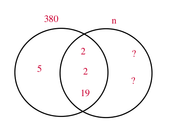
However, it does not tell us whether n has at least TWO factors of 19. Insufficient.
2) 5,776 is the least common multiple of 304 and n
A least common multiple tells us all of the prime factors contained between the two numbers, excluding any overlap. For example, the least common multiple of 18 and 30 is 90:
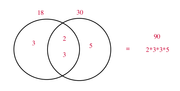
So to find out what this statement tells us about n, take the prime factorization of both numbers given:
5,776 = 2*2*2*2*19*19
304 = 2*2*2*2*19
This tells us that between 304 and n, they must together contain all of the prime factors of 5,776. We don't care about the 2's, just the 19's. 5,776 has two factors of 19, and 304 has only one. So n must have at least one. But if it only had one...
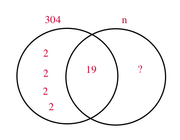
That 19 would be an "overlap." Since we need two factors of 19 overall, n itself must have at least two factors of 19. Sufficient.
The answer is
B.























