Is this one merely a plug and chug question ? whats the shortcut for this one? (answer is 'D' btw)
BREAKING: Target Test Prep releases Brand New 2026 On Demand GMAT prep course
RedeemTarget Test Prep · GMAT
Learn live with an expert or move at your own pace. Every option includes the complete TTP study system.


with Josh Braslow, 20+ years in test prep

Self-paced EA prep. Study on your schedule.

with Logan Thompson
Complete access from day one. Study on your schedule.
Compare the format, schedule, and included access before enrolling. Prices and seat counts shown reflect the supplied offer details.

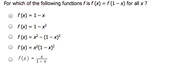
Let's use the INPUT-OUTPUT approach (aka plug and chug).For which of the following functions f is f(x)=f(1-x) for all x?
A) f(x) = 1-x
B) f(x) = 1-x²
C) f(x) = x² - (1-x)²
D) f(x) = x²(1-x)²
E) f(x) = x/(1-x)


Using D) f(x) = x²(1-x)²Brent@GMATPrepNow wrote:Let's use the INPUT-OUTPUT approach (aka plug and chug).For which of the following functions f is f(x)=f(1-x) for all x?
A) f(x) = 1-x
B) f(x) = 1-x²
C) f(x) = x² - (1-x)²
D) f(x) = x²(1-x)²
E) f(x) = x/(1-x)
So, let's use a "nice" value for x.
How about x = 0?
So, we can reword the question as, For which of the following functions is f(0)=f(1-0)
In other words, we're looking for a function such that f(0) = f(1)
A) f(x)=1-x
f(0)=1-0 = 1
f(1)=1-1 = 0
Since f(0) doesn't equal f(1), eliminate A
B) f(x) = 1 - x²
f(0) = 1 - 0² = 1
f(1) = 1 - 1² = 0
Since f(0) doesn't equal f(1), eliminate B
C) f(x) = x² - (1-x)²
f(0) = 0² - (1-0)² = -1
f(1) = 1² - (1-1)² = 1
Since f(0) doesn't equal f(1), eliminate C
D) f(x) = x²(1-x)²
f(0) = 0^2(1-0)^2 = 0
f(1) = 1^2(1-1)^2 = 0
Since f(0) equals f(1), keep D for now
E) f(x) = x/(1-x)
f(0) = 0/(1-0) = 0
f(1) = 1/(1-1) = undefined
Since f(0) doesn't equal f(1), eliminate E
Since only D satisfies the condition that f(x)=f(1-x) when x=0, the correct answer is D
Here's a similar question: https://www.beatthegmat.com/number-systems-t270738.html
Cheers,
Brent
f(1-x) = f(2) = (2)²(-1)² = 4Mathsbuddy wrote: Using D) f(x) = x²(1-x)²
If x = -1:
f(-1) = 1²(2)² = 4
Using f(x)=f(1-x)
If x = -1
f(1-x) = f(2) = 16
Therefore surely D cannot be correct for all values of x?




















