
BREAKING: Target Test Prep releases Brand New 2026 On Demand GMAT prep course

Redeem

Triangles and Semicircles

Expert replies
by masuarezdl » Sat Jan 31, 2009 12:16 pm
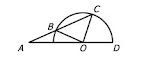
Image

In the figure shown, point O is the center of the semicircle and points B, C, and D lie on the semicircle. If the length of line segment AB is equal to the length of line sement OC, what is the degree measure of angle BAO?

(1) The degree measure of angle COD is 60°.
(2) The degree measure of angle BCO is 40°.

I certainly dont see a way to solve this... Anybody?
Join the discussion
Source: — Data Sufficiency |

Re: Triangles and Semicircles

by vikram_k51 » Sat Jan 31, 2009 12:32 pm
--------------------------------------------------------------------------------


In the figure shown, point O is the center of the semicircle and points B, C, and D lie on the semicircle. If the length of line segment AB is equal to the length of line sement OC, what is the degree measure of angle BAO?

(1) The degree measure of angle COD is 60°.
(2) The degree measure of angle BCO is 40°.

I guess the answer is C.

From the question:

AB=OC=OB(Since OC=OB=radius)

<BAO=<BOA(ABC is isoceles)

OBC=OCB(ISoceles)

Thus <OCB=<OBC

EAch alone is not sufficient.

Now taking A & B together

<BOC=180-80=100

<BOA=20=<BAO

Hence sufficient

Thus C
Join the discussion

Re: Triangles and Semicircles

by masuarezdl » Sat Jan 31, 2009 12:59 pm
Vikram, the correct answer choice is D, according to the book. But I have no idea why. Because so far, the triangle can be equilatera or isoceles.

I concluded the same as you, but unfortunately it is incorrect.
Join the discussion

by ontopofit » Sat Jan 31, 2009 1:13 pm
this requires a long answer :(
i will tell in short
statement 1) cod = 60

so, coa = 120
bao + coa + aco = 180
thus bao + aco = 60
aco = cbo
so, bao + cbo =60
cbo = 2bao
hence bao = 20 and suff.

statement 2) aco = 40
aco = cbo
cbo = 2bao
hence bao = 20 and suff.


so answer is D. please just apply the angle sum prop of a triangle and exterior angle prop. of a triangle.
Join the discussion

by antoni » Sat Mar 07, 2009 1:09 am
ontopofit wrote:this requires a long answer :(
i will tell in short
statement 1) cod = 60

so, coa = 120
bao + coa + aco = 180
thus bao + aco = 60
aco = cbo
so, bao + cbo =60
cbo = 2bao
hence bao = 20 and suff.

statement 2) aco = 40
aco = cbo
cbo = 2bao
hence bao = 20 and suff.


so answer is D. please just apply the angle sum prop of a triangle and exterior angle prop. of a triangle.
Hi ontopofit,
I got the answer B but it wasnt the answer. Why I chose B was because I could not understand why:
cbo = 2bao

pls can you explain more? Thanks
Join the discussion

by Brent@GMATPrepNow » Sat Mar 07, 2009 7:52 am
Here's my visual solution.
Please note that I only address why Statement (1) is sufficient, since there already seems to be agreement/understanding regarding the sufficiency of Statement (2)

Image
Brent Hanneson - Creator of GMATPrepNow.com
Image
Join the discussion

by antoni » Sat Mar 07, 2009 8:55 am
Brent Hanneson wrote:Here's my visual solution.
Please note that I only address why Statement (1) is sufficient, since there already seems to be agreement/understanding regarding the sufficiency of Statement (2)

Image
Thank you Brent Hanneson!
Join the discussion

by Vemuri » Sun Mar 08, 2009 1:29 am
Thanks Brent. That was a good explanation.
Join the discussion

by trumpet1184 » Mon Jul 27, 2009 7:22 pm
This solution makes sense once we establish the fact that AC is a line segment. However, let's back up one step.

How do we know that AC is one continuous line segment (alternatively, how do we know angle ABC = 180 degrees)? I haven't found anything in the question stem that suggests this - we cannot assume this picture to be drawn to scale.
Join the discussion

by navalpike » Mon Aug 10, 2009 1:19 pm
Can anyone access the image provided above by Brent. If so, can you please repost? When I try, it literally tells me that the "link is broken" :(

EDIT: I can access it now.
Last edited by navalpike on Thu Aug 13, 2009 2:45 pm, edited 2 times in total.
Join the discussion

Help

by mgshorrGMAT » Mon Aug 10, 2009 5:28 pm
Someone please explain why CBO=2BAO...

I thought I was good at geometry until this problem.


Mark
Join the discussion

Waaaait a second

by mgshorrGMAT » Mon Aug 10, 2009 5:35 pm
I think I figured it out...CBO=2BAO:


1. AB=OC
2. OC=OB (Both are radii)
2.5 OB=AB
3. <BOA=<BAO (Isosceles Triangle)
4. <CBO=2BAO (CBO is the exterior angle of the triangle, equal to the sum of the two non-adjacent angles.)

Let me know if I'm wrong.


Mark
Join the discussion

by pkw209 » Mon Feb 01, 2010 5:05 pm
sounds about right. thanks
Join the discussion

by tienvunguyen » Fri Feb 05, 2010 12:58 pm
Has anyone been able to answer trumpet1184's question? I think this is a valid question. We cannot assume that A,B,C are on a straight line.

Is this one of those GMAT questions where the assumption is so subtle that it is allowed/ignored?
Join the discussion

by Ian Stewart » Fri Feb 05, 2010 1:18 pm
tienvunguyen wrote:Has anyone been able to answer trumpet1184's question? I think this is a valid question. We cannot assume that A,B,C are on a straight line.

Is this one of those GMAT questions where the assumption is so subtle that it is allowed/ignored?
The instructions at the beginning of the Quant section of the GMAT state explicitly that points in a diagram which appear to be in a straight line can be assumed to in fact be in a straight line. So if you see something that looks like a line on your GMAT, it's not a circle or a something - it's definitely a line.
For online GMAT math tutoring, or to buy my higher-level Quant books and problem sets, contact me at ianstewartgmat at gmail.com

ianstewartgmat.com
Join the discussion

















