Note: I've reworded the target question so that it's an actual question.
Does the line y1 = mx + b pass through the point (2, -1)?
1) y1 is perpendicular to the line y2 = -(1/2)x + 9
2) b = -5
IMPORTANT: For geometry (including coordinate geometry) Data Sufficiency questions, we are typically checking to see whether the statements "lock" a particular line, angle, length, or shape into having just one possible measurement. This concept is discussed in much greater detail in our free video:
https://www.gmatprepnow.com/module/gmat- ... cy?id=1103
This technique can save a lot of time.
Here, we want to determine whether or not the statements lock us into having 1 and only 1 line.
Target question: Does the line y1 = mx + b pass through the point (2, -1)?
Statement 1: y1 is perpendicular to the line y2 = -(1/2)x + 9
Here's the line y2 = -(1/2)x + 9
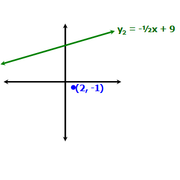
As you can see, there are MANY MANY MANY lines that are perpendicular to this line.
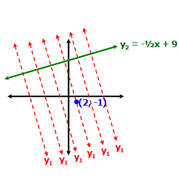
So,
the line y1 = mx + b MAY or MAY NOT pass through the point (2, -1))
Since we cannot answer the
target question with certainty, statement 1 is NOT SUFFICIENT
Statement 2: b = -5
This tells us that the line y1 = mx + b has y-intercept -5
In other words, the line y1 = mx + b must pass through the point (0, -5)
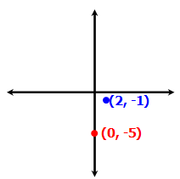
There are MANY MANY MANY different lines that pass through the point (0, -5)
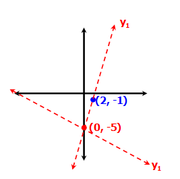
As you can see,
the line y1 = mx + b MAY or MAY NOT pass through the point (2, -1))
Since we cannot answer the
target question with certainty, statement 2 is NOT SUFFICIENT
Statements 1 and 2 combined
Statement 1 tells us that the line y1 = mx + b can be among the many dotted red lines that are perpendicular to the green line.
Statement 2 says that the line must also pass through the point (0, -5)
This LOCKS us into 1 and only 1 line.
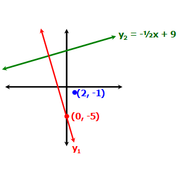
Since the statements lock us into just 1 line, we have enough information to determine whether or not
the line y1 = mx + b passes through the point (2, -1))
Since we can answer the
target question with certainty, the combined statements are SUFFICIENT
Answer =
C
IMPORTANT: Need we find the equation of the line? Need we actually determine whether or not the line passes through (2, -1)? No and no. We need only recognize that, since there's only 1 line that satisfies both statements, we COULD find the equation of the line and we COULD determine whether is passes through (2, -1)
Cheers,
Brent























