-
[email protected]
- Master | Next Rank: 500 Posts
- Posts: 429
- Joined: Wed Sep 19, 2012 11:38 pm
- Thanked: 6 times
- Followed by:4 members
QR-162
This topic has expert replies
Source: Beat The GMAT — Problem Solving |
- kevincanspain
- GMAT Instructor
- Posts: 613
- Joined: Thu Mar 22, 2007 6:17 am
- Location: madrid
- Thanked: 171 times
- Followed by:64 members
- GMAT Score:790
- Atekihcan
- Master | Next Rank: 500 Posts
- Posts: 149
- Joined: Wed May 01, 2013 10:37 pm
- Thanked: 54 times
- Followed by:9 members
You have posted the same problem one week ago and I've already posted a solution there : https://www.beatthegmat.com/qr-161-t231724.html#640620
-
[email protected]
- Master | Next Rank: 500 Posts
- Posts: 429
- Joined: Wed Sep 19, 2012 11:38 pm
- Thanked: 6 times
- Followed by:4 members
-
[email protected]
- Master | Next Rank: 500 Posts
- Posts: 429
- Joined: Wed Sep 19, 2012 11:38 pm
- Thanked: 6 times
- Followed by:4 members
- GMATGuruNY
- GMAT Instructor
- Posts: 15539
- Joined: Tue May 25, 2010 12:04 pm
- Location: New York, NY
- Thanked: 13060 times
- Followed by:1906 members
- GMAT Score:790
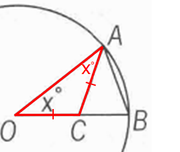
Since OC=AC=AB, we get:

In ∆AOC, y + 2x = 180.
Since y and z form a straight line, y + z = 180.
Thus:
y + 2x = y + z
2x = z.
The result is the following:

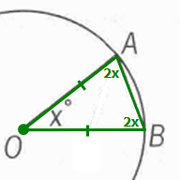
Since OA and OB are radii, OA=OB.
Thus, in ∆OAB, the angles opposite OA and OB are equal:

Since the sum of the angles inside ∆OAB = 180, we get:
x + x + x + 2x = 180
5x = 180
x = 36.
The correct answer is B.
Private tutor exclusively for the GMAT and GRE, with over 20 years of experience.
Followed here and elsewhere by over 1900 test-takers.
I have worked with students based in the US, Australia, Taiwan, China, Tajikistan, Kuwait, Saudi Arabia -- a long list of countries.
My students have been admitted to HBS, CBS, Tuck, Yale, Stern, Fuqua -- a long list of top programs.
As a tutor, I don't simply teach you how I would approach problems.
I unlock the best way for YOU to solve problems.
For more information, please email me (Mitch Hunt) at [email protected].
Student Review #1
Student Review #2
Student Review #3
Followed here and elsewhere by over 1900 test-takers.
I have worked with students based in the US, Australia, Taiwan, China, Tajikistan, Kuwait, Saudi Arabia -- a long list of countries.
My students have been admitted to HBS, CBS, Tuck, Yale, Stern, Fuqua -- a long list of top programs.
As a tutor, I don't simply teach you how I would approach problems.
I unlock the best way for YOU to solve problems.
For more information, please email me (Mitch Hunt) at [email protected].
Student Review #1
Student Review #2
Student Review #3

-
[email protected]
- Master | Next Rank: 500 Posts
- Posts: 429
- Joined: Wed Sep 19, 2012 11:38 pm
- Thanked: 6 times
- Followed by:4 members
GMAT/MBA Expert
- Brent@GMATPrepNow
- GMAT Instructor
- Posts: 16207
- Joined: Mon Dec 08, 2008 6:26 pm
- Location: Vancouver, BC
- Thanked: 5254 times
- Followed by:1268 members
- GMAT Score:770
Since OC = AC, ∆AOC is an isosceles triangle, which means ∠OAC is also x°[email protected] wrote:In the figure above, point O is the center of the circle and OC=AC=AB. What is the value of x?
A) 40
B) 36
C) 34
D) 32
E) 30

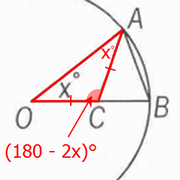
Since all 3 angles in ∆AOC must add to 180°, we can conclude that ∠OCA = (180-2x)°

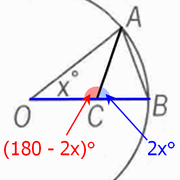
Since angles on a LINE must add to 180°, we can conclude that ∠ACB = 2x°

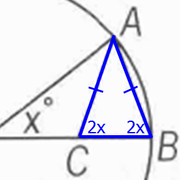
Since AC = AB, ∆ACB is an isosceles triangle, which means ∠CBA is also 2x°

Finally, since OA and OB are radii of the same circle, we know that ∆OAB is an isosceles triangle, which means ∠OABis also 2x°

At this point, we can see that the 3 angles ∆OAB are x°, 2x° and 2x°
Since the angles in a triangle must add to 180°, we can write: x° + 2x° + 2x° = 180°
Simplify: 5x = 180
Solve: x = 36
Answer: B