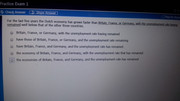
For the last five years the Dutch economy has grown faster than Britain, France, or Germany, with the unemployment rate having remained well below that of the other three countries.
Finding the right answer to this question requires finding rhetorical construction issues that affect the meaning conveyed. You barely need to know any grammar rules in order to hack your way to the correct choice.
A. Britain, France, or Germany, with the unemployment rate having remained
Using this answer choice creates a sentence that says that the Dutch economy has grown faster than Britain, France or Germany. Britain, France and Germany are growing? In what sense? I think the comparison is meant to be between the Dutch economy and the economies of the other countries. So I guess this one can be eliminated.
B. have those of Britain, France, or Germany, and the unemployment rate remaining
This choice has an actual grammar issue in that
those of does not work with
Britain, France, or Germany. A list using the word
or gives one a choice between single elements. So to match a single element, we need
that of rather than
those of.
There is also a parallelism issue. We have
the Dutch economy has grown in a non parallel list with
the unemployment rate remaining.
C. have Britain, France, and Germany, and the unemployment rate has remained
Once again this compares the growth of the Dutch economy with the growth of countries, whatever that means.
Also, it's not clear whose unemployment rate
the unemployment rate is.
D. the economy of Britain, France, and Germany, with the unemployment rate that has remained
Well this one does compare the Dutch economy to another economy, but now that other economy is
the economy of Britain, France and Germany, as if the three share one economy.
Also, the use of the expression
the unemployment rate that has remained conveys that the Dutch economy has a particular employment rate, the one that has remained well below that of the other three countries. I don't believe that that is what is meant to be conveyed here.
Also, the expression
with the unemployment rate could be seen as conveying that the Dutch economy has grown with the unemployment rate, a meaning that does not really make sense.
E. the economies of Britain, France, and Germany, and the unemployment rate has remained
This one is not perfect. It still says "the unemployment rate", which to me could mean any unemployment rate. Still, the sentence created using this choice does effectively convey that the Dutch economy has grown faster than the other economies, and there are no grammatical issues, and so this choice is better than any of the others. Also given the context I guess one can infer that
the unemployment rate is the Dutch unemployment rate, though I would prefer that the sentence actually say that.
So imperfect as it may be,
E is the best answer.