BREAKING: Target Test Prep releases Brand New 2026 On Demand GMAT prep course

Redeem

In the diagram above, points A, B, C, D, and E represent the

Expert replies
by AAPL » Thu Nov 01, 2018 4:48 am

Timer

00:00

Answers

A

B

C

D

E

Stats

Difficulty

GMAT Paper Tests

Image

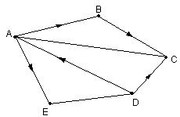
In the diagram above, points A, B, C, D, and E represent the five teams in a certain league in which each team must play each of the other teams exactly once. The segments connecting pairs of points indicate that the two corresponding teams have already played their game. The arrows on the segments point to the teams that lost; the lack of an arrow on a segment indicates that the game ended in a tie. After all games have been played, which of the following could NOT be the percent of games played that ended in a tie?

A. 10%
B. 20%
C. 30%
D. 40%
E. 50%

OA A
Join the discussion
Source: — Problem Solving |

by fskilnik@GMATH » Thu Nov 01, 2018 5:59 am
AAPL wrote:GMAT Paper Tests

Image

In the diagram above, points A, B, C, D, and E represent the five teams in a certain league in which each team must play each of the other teams exactly once. The segments connecting pairs of points indicate that the two corresponding teams have already played their game. The arrows on the segments point to the teams that lost; the lack of an arrow on a segment indicates that the game ended in a tie. After all games have been played, which of the following could NOT be the percent of games played that ended in a tie?

A. 10%
B. 20%
C. 30%
D. 40%
E. 50%
$$?\,\,\,:\,\,\,{\rm{impossible}}\,\,\% \,\,{\rm{tie}}\,\,{\rm{pairs}}$$
$${\rm{Total}}\,\,\# \,\,{\rm{games}}\,\,\,{\rm{ = }}\,\,\,{\rm{C}}\left( {5,2} \right)\,\, = \,\,10\,\,\,\left\{ \matrix{
\,5\,\,{\rm{victory - loss}}\,\,{\rm{pairs}} \hfill \cr
\,2\,\,{\rm{tie}}\,\,{\rm{pairs}} \hfill \cr
\,\left( * \right)\,\,{\rm{ = }}\,\,\,{\rm{remaining}}\,\,3\,\,{\rm{pairs}} \ldots \,\,{\rm{what}}? \hfill \cr} \right.$$
$$\left( * \right)\,\,\, = \,\,\,3\,\,{\rm{victory - loss}}\,\,{\rm{pairs}}\,\,\,\,\,\, \Rightarrow \,\,\,\,\,\,\left\{ \matrix{
\,5 + 3\,\,{\rm{victory - loss}}\,\,{\rm{pairs}} \hfill \cr
\,2\,\,{\rm{tie}}\,\,{\rm{pairs}} \hfill \cr} \right.\,\,\,\,\,\,\,\, \Rightarrow \,\,\,\,\,\,\min \left( {\,\% \,\,{\rm{tie}}\,\,{\rm{pairs}}\,} \right) = {2 \over 10} = 20\% $$

The correct answer is therefore (A).


This solution follows the notations and rationale taught in the GMATH method.

Regards,
Fabio.
Fabio Skilnik :: GMATH method creator ( Math for the GMAT)
English-speakers :: https://www.gmath.net
Portuguese-speakers :: https://www.gmath.com.br
Join the discussion

by Brent@GMATPrepNow » Thu Nov 01, 2018 5:59 am
AAPL wrote:GMAT Paper Tests

Image

In the diagram above, points A, B, C, D, and E represent the five teams in a certain league in which each team must play each of the other teams exactly once. The segments connecting pairs of points indicate that the two corresponding teams have already played their game. The arrows on the segments point to the teams that lost; the lack of an arrow on a segment indicates that the game ended in a tie. After all games have been played, which of the following could NOT be the percent of games played that ended in a tie?

A. 10%
B. 20%
C. 30%
D. 40%
E. 50%

OA A
points A, B, C, D, and E represent the five teams in a certain league in which each team must play each of the other teams exactly once.
Let's first determine the total number of games that will be played.
There are 5 teams, so each team will play 4 games (since a team can't play itself)
So, the total number of games = (5)(4) = 20
From here we need to recognize that every game has been counted TWICE.
For example, if Team A and Team B play a game, then Team A counts it as a game, AND Team B counts it as a game. Of course only one game occurred.
To account for the duplication, we'll divide 20 by 2 to get 10
So, there will be a total of 10 games.

After all games have been played, which of the following could NOT be the percent of games played that ended in a tie?
Scan the answer choices.
Answer choice A says 10%
In order to have 10% of the games ending in a tie, we need 1 of the 10 games to end in a tie.
However, from the diagram, we can see that 2 ties have already occurred.
So, answer choice A is cannot happen.

Answer: A

Cheers,
Brent
Brent Hanneson - Creator of GMATPrepNow.com
Image
Join the discussion